
Year of AI 2026: Redefining Saudi Capital Allocation
Vision 2030
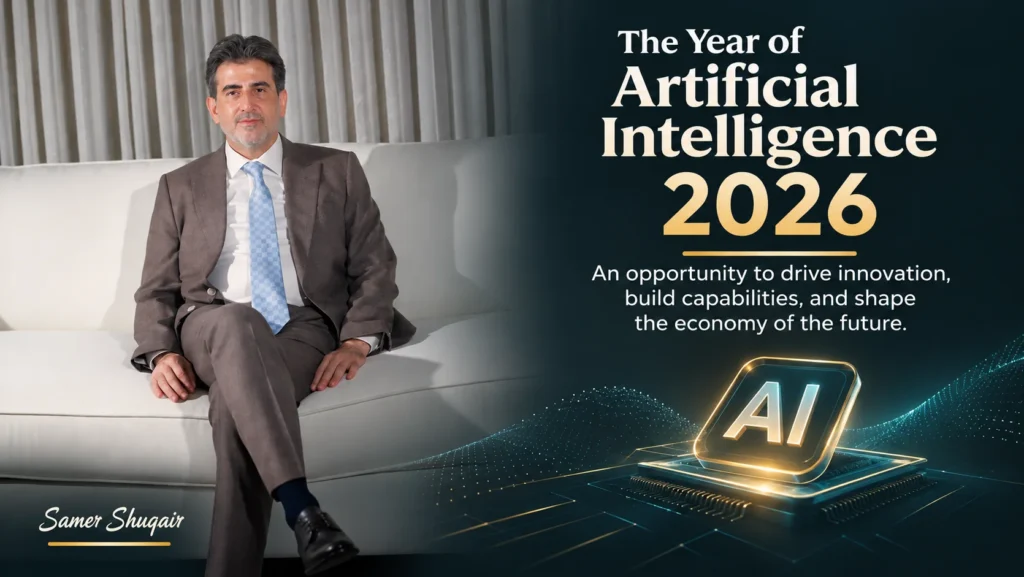
Samer Choucair’s reading of Saudi Arabia’s Year of AI 2026 and the closing of the HUMAIN deal between the Public Investment Fund and Aramco: why this shift marks a move from technological ambition to building real computing capacity, and what it means for institutional investors in the Saudi economy.
Samer Choucair, investment entrepreneur
I see the declaration of 2026 as the Year of AI 2026, coinciding with the closing of the HUMAIN deal between the Public Investment Fund and Aramco, as a transition from announcing technological ambition to building actual computing capacity inside the Saudi economy. In my assessment, this shift matters to institutional investors because it links non oil diversification with control over one of the most important assets of the digital economy this decade: energy and data infrastructure.
I notice that the Kingdom, a decade into Vision 2030, is clearly moving toward building local productive capacity in strategic sectors, rather than simply importing technology or relying on consumption models. The recent deal, in which the Fund kept a controlling 51% stake while Aramco entered with 49% and a cash contribution of about 9.9 billion riyals, reflects a different investment logic: combining technology assets with the financial and operational strength of an energy giant to create a platform capable of regional and global expansion.
In this article, on the Samer Choucair platform, we present Samer’s reading of what the Year of AI 2026 means for capital allocation, from the economic context to opportunities, risks, and possible scenarios, along with a practical framework that helps investors assess the “quality of capital”, not just its size.
Key Takeaways
- From ambition to capacity: The Year of AI 2026 marks a move from announcing technological ambition to building real computing capacity.
- Energy and data as one asset: Linking Aramco with HUMAIN aims to integrate energy, infrastructure, and data into one system.
- Quality of capital before size: The question: is the funding building real operating assets, or just media driven expansion?
- Selective opportunities: Digital infrastructure, data centres linked to renewable energy, and Arabic language solutions.
- A margin of safety is essential: The costs of expanding in AI remain high and not fully certain.
Table of Contents
- What Does the Year of AI 2026 Mean for Investors?
- The HUMAIN Deal: A Different Investment Logic
- The Economic Context: A Phase of Selective Harvest
- Capital Allocation in the Year of AI 2026
- Opportunities and Risks
- The Saudi and Gulf Economy: Repositioning
- Future Scenarios
- A Practical Framework for Assessing Quality of Capital
- Frequently Asked Questions
- Conclusion
What Does the Year of AI 2026 Mean for Investors?
Short Answer
Samer Choucair sees the Year of AI 2026 in the Kingdom as a move from announcing technological ambition to building real computing capacity, and believes it redefines capital allocation: from funding giga projects to favouring assets that combine long term growth with the ability to scale without continuous injections from the public budget.
For investors, the importance of the Year of AI 2026 lies not in the headline itself, but in what it reveals about the direction of sovereign and private capital. When the state and its largest companies move toward computing and data, priorities across the entire Saudi economy are reordered: where assets are built, who owns them, how they are financed, and what kind of returns are expected from them.
Reading the Year of AI 2026 therefore requires a double lens: an economic lens that sees the structural shift within Vision 2030, and an investment lens that separates assets building real value from waves fuelled by general optimism.
The HUMAIN Deal: A Different Investment Logic
The deal announced as closed in early November 2026 brings together two parties of very different natures: the Public Investment Fund as the sovereign investor holding the vision and the controlling stake, and Aramco as an energy giant with financial and operational strength. According to the announcement, the Fund retained a 51% stake, while Aramco entered with 49% and a cash contribution of about 9.9 billion riyals.
Samer Choucair reads this structure as an attempt to create a platform capable of regional and global expansion, not just a technology company dependent on government funding. Modern computing needs huge, stable energy, and Aramco adds that dimension directly to HUMAIN. That makes the deal one of the clearest signals of the direction of the Year of AI 2026.
| Party | Stake | What It Brings |
|---|---|---|
| Public Investment Fund | 51% | Sovereign vision and strategic control |
| Aramco | 49% | Financial and operational strength and energy expertise |
| Joint platform | HUMAIN | Computing capacity able to scale regionally and globally |
The Economic Context: A Phase of Selective Harvest
In light of the Crown Prince’s announcement that Vision 2030 programmes have achieved 93% of their targets, that the private sector’s contribution has risen to 51%, and that non oil exports have grown by 155% compared with 2016, Samer believes the Saudi economy has entered a phase that can be described as a “selective harvest”.
Samer Choucair (translated from Arabic)
It is no longer only about launching giga projects, but about turning those projects into assets capable of attracting private capital and generating sustainable cash flows.
Here Samer draws on Michael Porter’s The Competitive Advantage of Nations, which argues that national competitive advantage does not come from focusing on a single sector, but from building an interconnected system of supporting industries and institutions capable of continuous innovation. Samer believes that linking Aramco with HUMAIN is an attempt to apply this logic to the digital economy, where energy, infrastructure, and data become integrated elements instead of remaining separate.
The same logic applies at company level: advantage comes not from a single product but from a system that is hard to copy, as the article on competitive advantage explains. In the context of the Year of AI 2026, an integrated system linking energy and data becomes the advantage regional competitors will find hardest to replicate.
Capital Allocation in the Year of AI 2026
In Samer’s view, institutional capital currently tends to favour assets that combine long term growth with the ability to scale without continuous injections from the public budget. The HUMAIN deal, together with the additional financing the company secured to develop computing capacity and power infrastructure, signals in his assessment that the Fund is seeking to redistribute risk between sovereign entities and the private sector. For investors, this is one of the most practical signals of the Year of AI 2026.
Samer links this to Morgan Housel’s argument in The Psychology of Money about the importance of patience and discipline in capital allocation, away from short term excitement. The noise surrounding the Year of AI 2026 may tempt investors into quick decisions, while a good investment decision needs a longer horizon.
Samer Choucair (translated from Arabic)
The new generation of investors in the Gulf needs to develop the skill of reading the “quality of capital”, not just its size: whether the funding is building real operating assets or merely media driven expansion.
The ability to expand without continuous funding is the essence of the difference between growth and true scaling, the subject of the article on how to scale a business. A scalable asset adds revenue faster than costs, while an asset that needs fresh funding with every step of growth remains a burden on whoever finances it.
Opportunities and Risks
Samer sees clear opportunities in digital infrastructure, data centres linked to renewable energy, and solutions designed for the Arabic language, because the local and regional market remains relatively unsaturated in these areas. On the other hand, he sees risk in overvaluing AI companies that rely on high capital spending without a clear revenue model, especially if global pressure on energy and chip costs continues. Separating these two groups is the core investment task of the Year of AI 2026.
|
Digital infrastructure A relatively unsaturated market, directly tied to the Kingdom’s push to build local computing capacity. |
Data centres and renewable energy Combines the Kingdom’s energy advantage with growing computing needs. |
|
Arabic language solutions A clear gap in the local and regional market for solutions designed for Arabic speaking users. |
| ✕ |
The Main Risk in the Year of AI 2026Overvaluing companies that depend on high capital spending without a clear revenue model, amid global pressure on energy and chip costs. |
The Saudi and Gulf Economy: Repositioning
Samer observes that the Gulf economy as a whole is going through a phase of repositioning, as states seek to reduce reliance on direct sovereign spending and increase the participation of the private sector and foreign institutions. The Year of AI 2026 accelerates this shift. In Saudi Arabia specifically, the focus on AI within Vision 2030 opens room for private and family investment funds to take part in later stages of expansion, whether through infrastructure funds or partnerships in sector specific applications.
Samer leans toward investors allocating a considered portion of their portfolios to assets linked to digital energy and the logistics services that support it, while keeping a sufficient margin of safety, as Benjamin Graham advises in The Intelligent Investor, because the costs of expansion in this field remain high and not fully certain. This is a central point in reading the Year of AI 2026: enthusiasm for the sector does not remove the need for caution on size and price.
Future Scenarios
If current trends continue, Samer expects an acceleration in building local computing capacity over the next three to five years, strengthening the Kingdom’s appeal as a regional data hub, a direct outcome of the Year of AI 2026 if execution keeps pace. But he considers it likely that operating costs and reliance on global chip supply chains will remain sources of pressure.
| Factor | Supporting Trend | Pressure Point |
|---|---|---|
| Computing capacity | Faster local build out over 3 to 5 years | High operating costs |
| Supply chains | Sovereign and private partnerships | Reliance on global chips |
| Revenue | Sector specific applications | Models that rely on infrastructure alone |
In Samer’s assessment, the most realistic scenario beyond the Year of AI 2026 is gradual growth supported by sovereign and private partnerships, with selective opportunities in companies that have a clear operating model and the ability to generate revenue from applications, not from infrastructure alone.
Samer prefers that institutional investors focus on assessing the quality of partnerships and the ability to control the value chain, rather than joining general waves of optimism about AI. He also believes that building local expertise in analysing technology and energy risk together will become a competitive advantage for investors in the Saudi economy in the coming years. That expertise may prove the most lasting dividend of the Year of AI 2026.
A Practical Framework for Assessing Quality of Capital
Based on the criteria Samer sets out in his reading of the Year of AI 2026, investors can ask the following questions before any decision involving AI companies or digital infrastructure:
- ☐Is the funding building real operating assets, or fuelling media driven expansion?
- ☐Does the company have a clear revenue model from applications, not from infrastructure alone?
- ☐How strong are the partnerships, and do they give the company control over an important part of the value chain?
- ☐Can the asset scale without continuous injections of funding?
- ☐How sensitive is the company to energy and chip costs?
- ☐Does the amount invested leave a sufficient margin of safety if expansion costs rise?
Organising these questions into a consistent method helps avoid decisions driven by enthusiasm, and the article on business decision making frameworks offers tools that support this. The louder the noise around the Year of AI 2026, the more valuable questions written in advance become.
Editorial Insight
In major technology waves, the winners are rarely those who enter first, but those who know exactly what they are buying, and at what price.
Disclaimer
This article presents an analytical reading and is not investment advice. Every investor has different circumstances, goals, and risk tolerance. Consult a licensed professional, verify regulations with the Capital Market Authority, and confirm deal details and figures with their official sources before making any decision.
Sources
Crown Prince statements on Vision 2030 targets (Saudi Press Agency and media reports, October 2026); announcement of the closing of the HUMAIN deal between the Public Investment Fund and Aramco (official statement, 1 November 2026); reports on additional financing for digital infrastructure. Intellectual references: Michael Porter, The Competitive Advantage of Nations; Morgan Housel, The Psychology of Money; Benjamin Graham, The Intelligent Investor.
Frequently Asked Questions
Why does the Year of AI 2026 matter for investors?
Samer Choucair sees it as a move from technological ambition to building real computing capacity, redefining capital allocation toward scalable assets with sustainable returns.
What is the HUMAIN deal between the Public Investment Fund and Aramco?
A deal announced as closed on 1 November 2026, in which the Fund kept a controlling 51% stake and Aramco entered with 49% and a cash contribution of about 9.9 billion riyals, according to the announcement.
What does reading the quality of capital mean?
Distinguishing between funding that builds real operating assets and sustainable cash flows, and funding that fuels media driven expansion without a clear revenue model.
Where does Samer Choucair see opportunities in AI?
In digital infrastructure, data centres linked to renewable energy, and solutions designed for the Arabic language.
What are the main risks?
Overvaluing companies that depend on high capital spending without a clear revenue model, and global pressure on energy and chip costs.
Conclusion
The Year of AI 2026 is not just a headline but a turning point in capital allocation within the Saudi economy: from funding ambition to building capacity, and from the size of capital to its quality. Investors who read this shift with awareness, and balance opportunity and risk with a sufficient margin of safety, will be better placed to benefit from the next phase.
How do you see AI affecting your portfolio or your business? Share your view, and follow Samer Choucair’s analysis of the Saudi economy and capital allocation in the coming phase.
Samer Choucair
Entrepreneur and investor writing about entrepreneurship, investment, strategic thinking, and business growth in the Arab world.