
The Rule of Real Investing: People First, Then Capital
Vision 2030
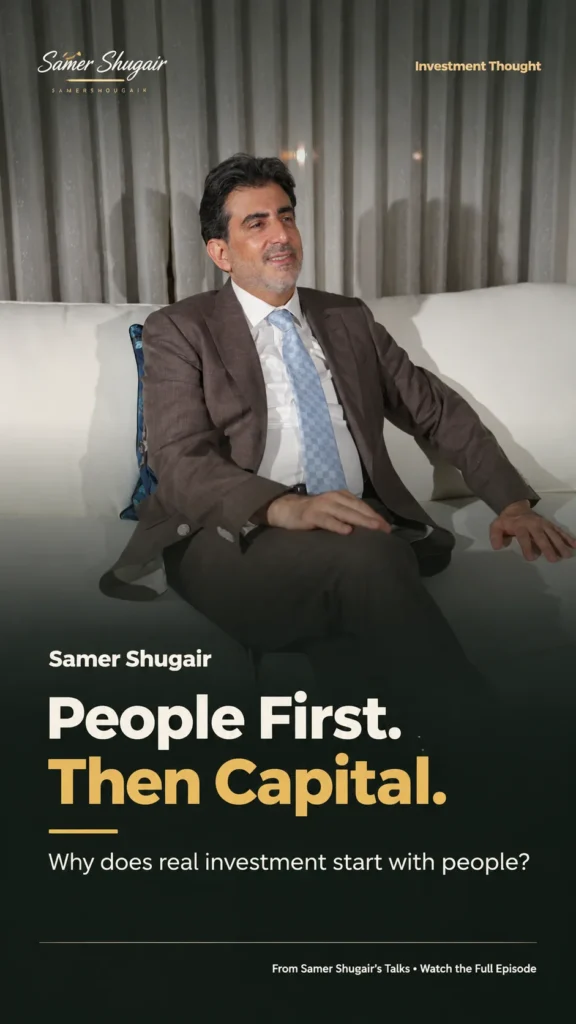
“People first. Then capital.” A phrase Samer Choucair raises in his “Investment Thinking” series, along with a question: why does real investing start with people? In this article, we look at how investors assess people before numbers, and how human capital is built inside companies.
Samer Choucair, investment entrepreneur
When investing is mentioned, attention usually goes to the numbers: the size of the funding, the expected return, the valuation, the cash flows. But behind every one of these numbers are people who make decisions, build products, lead teams, and deal with customers. When those people are in the wrong place, no amount of funding can save the business.
In his interviews, Samer Choucair sums up this idea in two sentences (translated from Arabic): “People first. Then capital.” And he asks a direct question alongside them: why does real investing start with people?
In this article, on the Samer Choucair platform, we look at this question from the perspective of both the investor and the business owner: what it means for real investing to start with people, why investors assess people before ideas, what they look for in a founding team, and how any company can build the human capital that makes capital work efficiently.
Key Takeaways
- Money follows people: Real investing starts with assessing who will manage the money, before assessing the idea itself.
- Ideas change, teams remain: Most businesses adjust their first idea, but the quality of the team determines their ability to adapt.
- Human capital is an asset: Skills, experience, and trust within a team are real assets, even if they do not appear on the balance sheet.
- Assessing people has criteria: Integrity, ability to learn, complementary founders, and an execution track record.
- Building is ongoing: Investing in people does not stop at hiring; it continues through development and empowerment.
Table of Contents
- What Does It Mean for Real Investing to Start With People?
- Why Do Investors Assess People Before Ideas?
- What Is Human Capital and Why Is It an Investment Asset?
- What Do Investors Look for in a Founding Team?
- How Do You Apply the People First Principle in Your Company?
- What Goes Wrong When Money Comes Before People?
- Real Investing in the Saudi Context and Vision 2030
- Frequently Asked Questions
- Conclusion
What Does It Mean for Real Investing to Start With People?
Samer Choucair (translated from Arabic)
People first. Then capital. Why does real investing start with people?
Short Answer
It means that real investing does not start with how much money is available, but with the people who will manage it and turn it into value. Money is a tool, and people decide how that tool is used. That is why a disciplined investor starts by assessing the team, its capabilities, and its integrity, and only then looks at the idea and the numbers.
Capital alone does not create value. The same amount of money can become a successful company in the hands of one team and a total loss in the hands of another. The difference between the two outcomes is not the money, but the quality of the decisions made by the people who managed it. That is where the idea that real investing starts with people comes from.
This does not mean the numbers are unimportant. It means reading them is incomplete without understanding who stands behind them. A business plan, however precise, remains a set of assumptions on paper; execution is what turns it into reality, and execution is done by people. Any serious approach to real investing has to account for that.
| When Money Comes First | When People Come First |
|---|---|
| Focus on the size of the funding | Focus on who will manage the funding |
| Assess the idea in isolation from the team | Assess the team’s ability to develop the idea |
| Hire quickly to fill gaps | Hire carefully to build a culture |
| Grow through spending | Grow through capabilities |
| Depend on one person | Build a team that can endure |
Why Do Investors Assess People Before Ideas?
Short Answer
Because ideas change as the market tests them, while the team remains the constant that determines the ability to learn, adapt, and execute. That is why many investors believe a strong team with an average idea is better than a weak team with an excellent one.
In venture capital, a saying attributed to American investor Arthur Rock, one of the earliest venture capitalists, is often repeated: he invests in people, not ideas. The logic is simple. Most startups change their first idea or business model at least once before finding their way, and the team that can read the market and adapt is the one that survives these shifts. For many venture investors, this is the essence of real investing.
That is why real investing at the early stages resembles a bet on people’s ability to solve problems that have not appeared yet. The investor cannot know what the business will face a year from now, but can assess how the team thinks, how it handles pressure, and whether it learns from its mistakes.
Even when investing in large listed companies, the quality of management remains one of the most important things investors assess. How management allocates capital, how honest it is with shareholders, and how well it builds strong teams all determine whether real investing in that company will deliver results over the long term.
Editorial Insight
The idea answers the question of what we will do. The team answers the more important question: can we do it, and can we learn when we get it wrong?
What Is Human Capital and Why Is It an Investment Asset?
Short Answer
Human capital is the sum of the knowledge, skills, experience, and capabilities individuals hold that can produce economic value. It is an investment asset because it requires investment in education and training, and it generates returns in the form of productivity, innovation, and growth capacity.
The concept of human capital developed in modern economics through economists such as Theodore Schultz, who published an article titled “Investment in Human Capital” in 1961, and Gary Becker, who published his book Human Capital in 1964. Both later received the Nobel Prize in Economics. Their core idea was that spending on a person’s education and training is not consumption but an investment with a return, like any other investment.
Inside companies, human capital appears in many forms that the balance sheet does not record directly:
|
Knowledge and experience The team’s understanding of the market, customers, and technology, and the lessons accumulated from past experience. |
Skills The ability to execute in sales, development, operations, and financial management. |
|
Culture and values Shared ways of working, integrity, commitment, and the ability to collaborate. |
Relationships The network of relationships with customers, suppliers, partners, and investors. |
The difference between financial capital and human capital is that the first can be moved or replaced relatively easily, while the second accumulates slowly through years of experience, learning, and working together. A company can raise new funding in months, but it may need years to build a cohesive team that understands the market and customers and whose members trust one another. That is why competitors find strong teams hard to copy, even when matching funding is sometimes easy.
When a key person leaves a company, part of these assets leaves with them. That is why real investing does not treat people as a cost to be minimised, but as assets to be developed and retained.
What Do Investors Look for in a Founding Team?
Short Answer
Investors look for five core elements in a founding team: integrity, the ability to learn, complementary skills among the founders, an execution track record, and a deep understanding of the problem the business solves.
When an investor decides that real investing starts with people, they need clear criteria for assessing them, not passing impressions. The most important of these criteria in real investing are:
| 01 |
Integrity Do the founders tell the truth even when it is not in their favour? Trust is the foundation of any long term investment relationship. |
| 02 |
Ability to learn Does the team change its mind when the evidence changes? Does it learn from its mistakes or justify them? |
| 03 |
Complementary founders Does the team cover the core skills such as product, sales, and operations, or are its members alike in everything? |
| 04 |
Execution track record What has the team actually achieved with the resources available, not just what it promises to achieve? |
| 05 |
Understanding the problem Do the founders know their customers and their problem deeply, or do they rely on untested assumptions? |
Assessing these criteria takes time, multiple conversations, and talks with former customers and partners. Using a clear method helps reduce the influence of first impressions, as the article on business decision making frameworks explains. Real investing needs a structured decision as much as it needs good intuition.
The qualities of the leader matter a great deal as well, and the article on essential leadership skills reviews the qualities that enable a founder to build and lead a team through different stages of growth.
How Do You Apply the People First Principle in Your Company?
Short Answer
You apply the people first principle inside a company through careful hiring, continuous development, real delegation, a culture built on trust and accountability, and retaining key talent.
The “people first” principle is not only for investors; it applies to every business owner who wants their capital to earn the best possible return. Real investing inside a company means that every riyal spent on the right people raises the value of every riyal spent anywhere else.
Hire Carefully
Hiring quickly to fill a temporary gap can cost far more than waiting. Look for alignment with your values as much as for skill, and ask about real situations from the candidate’s experience rather than theoretical answers. In real investing, the hiring decision is the first allocation of capital.
Develop Continuously
An employee who keeps learning adds growing value over time. Investing in training, mentoring, and growth opportunities is one of the clearest forms of real investing, because it raises the team’s ability to handle challenges that have not appeared yet.
Delegate and Empower
Hiring capable people is not enough; you have to give them real authority. A founder who keeps every decision wastes the human capital they invested in building. The article on how to delegate effectively as a leader explains how delegation becomes a tool for developing the team.
Retain Key Talent
Losing a key person can cost a company months of work, experience, and relationships. Retaining talent requires a respectful work environment, genuine recognition, and a clear growth path, not salary alone. Retention is where real investing protects what it has already built.
To assess whether you are truly applying this principle as a leader, the article on how to know if you’re a good leader offers practical questions worth answering honestly.
- ☐Do I assess alignment with values as much as skill when hiring?
- ☐Do I set aside a clear budget and time for developing the team?
- ☐Do I delegate real decisions with clear authority?
- ☐Do I know which key people would be hardest to replace?
- ☐Do I treat the team as an asset to develop or a cost to cut?
What Goes Wrong When Money Comes Before People?
Many businesses do not fail for lack of money, but because they spend it before building a team capable of using it. Among the most common mistakes that reflect the absence of real investing:
| ✕ |
Funding before readinessRaising large funding before the team has the capacity to manage it, so the money turns into fast spending with no results. |
| ✕ |
Depending on one personBuilding the whole business around the founder, without a team able to continue if they are absent or overstretched. |
| ✕ |
Ignoring cultureFocusing on numbers while neglecting the work environment, so talent leaks away and trust inside the team weakens. |
| ✕ |
Confusing financial and true partnershipAccepting an investor or partner for the money alone, without alignment on values, vision, and ways of working. |
Avoiding these mistakes starts with a simple question before any major financial decision: do we have the people who can turn this money into value? If the answer is no, then real investing starts with building that team first. For those beginning their entrepreneurial journey, the article on how to become an entrepreneur offers practical first steps.
Real Investing in the Saudi Context and Vision 2030
Saudi Vision 2030 places people at the heart of the economic transformation, and its programmes include the Human Capability Development Program, which focuses on developing skills and preparing citizens for a changing labour market. This direction reflects the same idea at the level of the whole economy: economic diversification is not achieved with money alone, but with the talent capable of building and running new sectors. That is real investing at a national scale.
As the entrepreneurship and venture capital ecosystem grows in the Kingdom, assessing the founding team becomes a core part of investors’ decisions, and human capital becomes a competitive advantage for companies that invest in developing national talent. Here real investing at the level of the individual, the company, and the economy meets at a single point: people first.
Disclaimer
This article is for general awareness and is not investment advice. Every investor has different circumstances, goals, and risk tolerance. Consult a licensed professional and verify regulations with the relevant authorities before making any decision.
Sources
Theodore W. Schultz, Investment in Human Capital, American Economic Review (1961); Gary S. Becker, Human Capital (1964); sayings attributed to Arthur Rock on investing in people; Human Capability Development Program documents, Saudi Vision 2030.
Frequently Asked Questions
What does it mean that real investing starts with people?
It means assessing the people who will manage the money and turn it into value comes before assessing the amount of money or the idea itself.
Why do investors invest in people before ideas?
Because ideas change as the market tests them, while the team determines the ability to learn, adapt, and execute.
What is human capital?
The sum of the knowledge, skills, and experience individuals hold that can produce economic value, a concept developed by economists such as Schultz and Becker.
What do investors look for in a founding team?
Integrity, the ability to learn, complementary skills, an execution track record, and a deep understanding of the problem.
How do I apply the people first principle in my company?
Through careful hiring, continuous development, real delegation, a culture of trust and accountability, and retaining key talent.
Does this principle mean the numbers do not matter?
No. The numbers matter, but reading them is incomplete without understanding the people behind them who make the decisions.
What is the biggest mistake when money comes before people?
Raising large funding before there is a team capable of managing it, so the money turns into fast spending without results.
Conclusion
“People first. Then capital.” is not only a humane phrase; it is a practical investment rule. Money follows the people who can turn it into value, and real investing starts with assessing, building, and empowering those people. Whoever understands this rule, investor or business owner, puts their capital where it works most efficiently.
Who is the person who made the biggest difference in your career or business? Share your experience, and follow the “Investment Thinking” series with Samer Choucair for more lessons in investing and entrepreneurship.
Samer Choucair
Entrepreneur and investor writing about entrepreneurship, investment, strategic thinking, and business growth in the Arab world.