
Investing in Vision 2030: A New Way to See Opportunity
Vision 2030
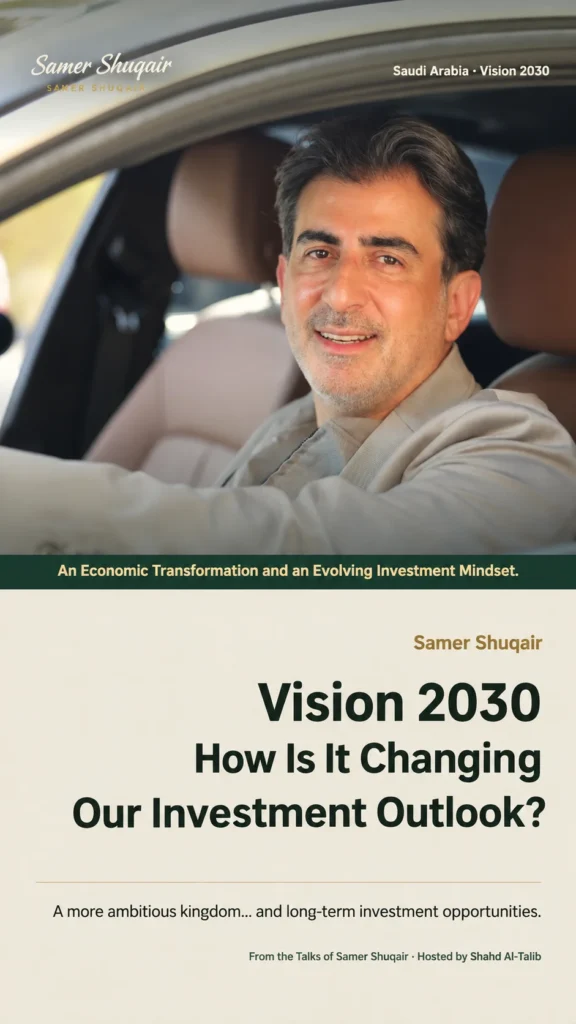
“The Kingdom’s ambition… and long-term investments.” A look at how the Vision has reshaped the way we think about investing in Saudi Arabia: from reliance on oil to economic diversification, from quick speculation to long term investing, and from the state acting alone to partnership with the private sector.
Samer Choucair, investment entrepreneur
Since its launch in 2016, Saudi Vision 2030 has not been just an economic plan read in official documents. It is a transformation that touches the thinking of anyone who has savings, a business, or an idea. When the shape of the economy changes, the shape of opportunity changes with it, and so does the question an investor should ask before any decision. That question sits at the heart of investing in Vision 2030.
In his interviews, Samer Choucair asks this question directly: how does the Vision change the way we look at investing? He sums up the answer in two phrases (translated from Arabic): “The Kingdom’s ambition… and long term investments” and “Economic transformation. And an investment mindset that renews itself.”
In this article, on the Samer Choucair platform, we explore the features of investing in Vision 2030: how the Vision has reshaped the way people look at investing in Saudi Arabia, what has changed in the structure of the economy, which sectors have opened their doors, what this means for individual investors and entrepreneurs, and how to build an investment mindset suited to the Vision’s long horizon.
Key Takeaways
- From oil to diversification: The Vision redirects the economy toward multiple non oil sectors.
- A long horizon by nature: Structural transformations take years to show results, which requires investment patience.
- The private sector as partner: The Vision gives the private sector a bigger role in the economy, and with it wider opportunities.
- A deeper capital market: Developing the capital market and diversifying its tools opens more options for investors.
- A renewing mindset: Investing in Vision 2030 begins with changing how you think before changing your portfolio.
Table of Contents
- What Is Saudi Vision 2030 and How Does It Relate to Investing?
- What Has Changed in Investing in Vision 2030?
- Which Sectors Has the Vision Opened to Investors?
- How Has the Saudi Capital Market Developed?
- What Role Do the Private Sector and Entrepreneurs Play?
- What Does Investing in Vision 2030 Mean for Individual Investors?
- How Do You Build an Investment Mindset Aligned With the Vision?
- What Risks Should You Watch For?
- Frequently Asked Questions
- Conclusion
What Is Saudi Vision 2030 and How Does It Relate to Investing?
Short Answer
Saudi Vision 2030 is the strategic plan Saudi Arabia launched in 2016 to diversify the economy and reduce reliance on oil. It rests on three pillars: a vibrant society, a thriving economy, and an ambitious nation. It relates to investing because it redistributes opportunity across sectors, gives the private sector a bigger role, and develops the capital market and its tools. Investing in Vision 2030 means directing savings and capital toward the opportunities the Vision creates in new sectors and instruments.
Samer Choucair (translated from Arabic)
Vision 2030: how does it change the way we look at investing? The Kingdom’s ambition… and long term investments.
The Vision is delivered through a set of Vision Realization Programs, including the Financial Sector Development Program, the Privatization Program, the Public Investment Fund Program, the Human Capability Development Program, the Quality of Life Program, and the National Industrial Development and Logistics Program. Each program has its own goals and target sectors, which makes the Vision a map of where capital is heading this decade, and the starting point for understanding investing in Vision 2030.
For investors, the importance of the Vision lies in how much it shapes where government and private investment will go, which sectors will receive support, regulation, and funding, and which skills and services will see rising demand. Understanding this map is the first step in any decision about investing in Vision 2030.
What Has Changed in Investing in Vision 2030?
Short Answer
The view of investing in Vision 2030 has shifted in four directions: from reliance on oil to diversification, from short term speculation to long term investing, from the state acting alone to partnership with the private sector, and from consumption to building local productive capacity.
Before the Vision, the Saudi economy moved largely with oil prices and government spending. Many individual investors focused on stocks and real estate, often with a short time horizon. With the Vision, this framework began to change on more than one level, and investing in Vision 2030 took on a different meaning.
| Before the Vision | With the Vision |
|---|---|
| Heavy reliance on oil | Diversification into multiple non oil sectors |
| The state as the main driver | Wider partnership with the private sector |
| Focus on stocks and real estate | Wider options: funds, sukuk, startups, new sectors |
| Mostly short time horizons | Structural shifts that require a long horizon |
| Importing most services and technologies | Building local productive capacity |
This is where Samer Choucair’s phrase comes in (translated from Arabic): “Economic transformation. And an investment mindset that renews itself.” Economic transformation is incomplete if investment thinking stays the same. An investor who reads the Vision through the lens of the past may miss new opportunities, or enter them with expectations that do not fit their nature.
From Speculation to the Long Term
The giga projects launched under the Vision, such as NEOM, the Red Sea, Qiddiya, ROSHN, and Diriyah, span many years. The sectors the Vision targets, such as tourism, industry, mining, and renewable energy, need time to mature. That is why long term investing is not a stylistic choice in this context, but a necessity imposed by the nature of the transformation itself. This is what sets investing in Vision 2030 apart from earlier waves of speculation.
Editorial Insight
Major economic transformations do not reward those who move in and out quickly, but those who understand the direction and stay with it long enough.
Which Sectors Has the Vision Opened to Investors?
One of the Vision’s most notable features is that it moved sectors that were limited or emerging into the heart of economic strategy. These are the sectors that now make up the map of investing in Vision 2030. Among the most prominent:
|
Tourism and hospitality The tourist visa opened in 2019, major tourism destination projects, and hosting global events such as Expo 2030 in Riyadh and the 2034 World Cup. |
Entertainment and culture A sector almost absent before the Vision, now a field of growing investment, projects, and events. |
|
Industry and mining The National Industrial Development and Logistics Program aims to localise industries and develop the mining sector. |
Technology and the digital economy Investment in digital infrastructure, artificial intelligence, and tech startups. |
|
Renewable energy Solar, wind, and hydrogen projects as part of diversifying energy sources. |
Logistics Investment in ports, airports, and transport to strengthen the Kingdom’s position as a hub connecting three continents. |
But a sector’s place in the Vision does not mean every company in it is a good opportunity. New sectors also attract waves of enthusiasm that can push valuations beyond what actual results justify. A disciplined investor distinguishes between the sector’s direction, the company’s quality, and the entry price, and this is the most important rule in investing in Vision 2030.
How Has the Saudi Capital Market Developed?
The Saudi capital market has gone through important changes in the context of the Vision. It opened to qualified foreign investors in 2015 and joined global emerging market indices such as MSCI and FTSE Russell in 2019. In December 2019, Aramco shares were offered to the public on the local market.
The range of available investment tools has also expanded, from exchange traded funds to sukuk and debt instruments, alongside the parallel market “Nomu” that allows smaller companies to list. The Financial Sector Development Program, one of the Vision programs, aims to deepen the market, diversify its tools, and promote saving and financial planning, all of which make investing in Vision 2030 more accessible to individuals.
This development means that investing in Vision 2030 is no longer limited to a few options. But it also means investors need more knowledge to understand the different tools and their risks before choosing among them.
What Role Do the Private Sector and Entrepreneurs Play?
Short Answer
The Vision gives the private sector a bigger role in the economy through privatization programs, public private partnerships, and support for small and medium enterprises, opening opportunities for entrepreneurs and investors in sectors previously run by the state.
One of the Vision’s stated goals is to raise the private sector’s contribution to GDP. This is pursued through the Privatization Program, which transfers some services and assets to the private sector, through partnerships between the two sectors, and through support for small and medium enterprises via bodies such as the Small and Medium Enterprises General Authority, “Monsha’at”.
This shift opens the door for entrepreneurs to build businesses that serve new sectors or fill gaps within them. Anyone thinking of entering this space will find a practical starting point in the article on how to become an entrepreneur. And for those who already run a business and want to benefit from the growth of these sectors, the article on how to scale a business explains how to expand without losing balance. Investing in Vision 2030 is no longer limited to buying shares; it includes building and growing businesses.
What Does Investing in Vision 2030 Mean for Individual Investors?
Short Answer
For individual investors, investing in Vision 2030 means wider choices and more diverse tools, but also greater responsibility for learning and planning, because new opportunities require deeper understanding and a longer horizon than traditional investments.
Major economic transformations are often seen as the business of governments and large corporations alone. But their impact ultimately reaches the everyday decisions of individuals: where they save, how they allocate their money, which skills they invest in learning, and which businesses they consider starting. In practice, investing in Vision 2030 is as much a personal decision as a national one.
An employee with monthly savings now has options that were not as easily available a few years ago, from index funds to sukuk and diversified investment funds. A young person thinking about a business finds new sectors that need local services and solutions. And the owner of a small business finds support and financing programs on a scale that did not exist before. Each of them experiences investing in Vision 2030 differently.
But wider choice does not mean easier decisions. The more tools there are, the greater the need to understand the differences between them, and to have a clear plan that sets the goal, the timeframe, and the acceptable level of risk. The individual investor who builds that plan calmly and sticks with it for years is best placed to benefit from investing in Vision 2030 without being swayed by every headline or passing wave of enthusiasm.
| Type of Investor | What Has Changed | What They Need |
|---|---|---|
| Salaried saver | More diverse and accessible investment tools | A regular allocation plan and a diversified instrument |
| Entrepreneur | New sectors and support programs | Understanding sector needs and a clear business model |
| Small business owner | Wider partnership and financing opportunities | Operational readiness to scale |
| Stock investor | A deeper market and greater foreign participation | Valuing companies, not chasing sectors |
How Do You Build an Investment Mindset Aligned With the Vision?
“An investment mindset that renews itself” means that investing in Vision 2030 starts with how you think before which assets you choose. Here are practical steps to build that mindset:
| 01 |
Understand the map before the opportunity Read the Vision programs and their goals, and learn the target sectors and the direction of spending and regulation in them. |
| 02 |
Think with a long horizon Set investment goals that span years, and avoid judging an emerging sector by a single quarter’s results. |
| 03 |
Diversify across sectors Do not bet on a single sector however promising it looks; economic diversification is a principle that works for a portfolio as well as for an economy. |
| 04 |
Separate direction from price A promising sector may trade at high valuations, and price is a core part of the decision. |
| 05 |
Keep building your knowledge Follow official reports, and learn new market tools before using them. |
Each of these steps is a decision that deserves a clear method, and the article on business decision making frameworks offers tools that help organise your thinking before major decisions, especially decisions about investing in Vision 2030.
- ☐Do I know which sectors the Vision targets?
- ☐Does my investment horizon match the nature of these sectors?
- ☐Is my portfolio spread across more than one sector?
- ☐Do I assess price and quality, not just direction?
- ☐Do I learn new tools before investing in them?
- ☐Do I treat investing in Vision 2030 as a long term plan rather than a passing wave?
What Risks Should You Watch For?
Any discussion of the opportunities in investing in Vision 2030 is incomplete without discussing the risks. Major transformations go through phases of adjustment and reprioritisation, and the timelines or scale of some projects may change as global economic conditions and energy prices shift.
| ✕ |
Chasing headlinesInvesting on the basis of an announcement or a news story without waiting for actual operating results. |
| ✕ |
Over concentrationPutting a large share of the portfolio into a single sector because it is linked to the Vision. |
| ✕ |
Ignoring valuationPaying high prices for companies in popular sectors without checking that expected earnings justify the price. |
| ✕ |
Short horizonExpecting quick results from sectors that by nature need years to mature. |
That is why investing in Vision 2030 requires combining optimism about the direction with caution in execution: a deep understanding of the sector, deliberate diversification, and a time horizon that matches the nature of the economic transformation.
It also helps to remember that economic diversification does not mean the influence of oil on the economy disappears overnight. Energy prices will remain a factor in liquidity and spending for years, and the balance between new and traditional sectors is forming gradually. That is why reading the economic transformation realistically, away from excessive optimism or pessimism, is the foundation of any balanced decision.
Disclaimer
This article is for general awareness and is not investment advice. Every investor has different circumstances, goals, and risk tolerance. Consult a licensed professional, verify regulations and licensed products with the Capital Market Authority, and confirm the details of Vision programs with their official sources before making any decision.
Sources
Saudi Vision 2030 document (2016) and the official Vision website, vision2030.gov.sa; Vision Realization Program documents, including the Financial Sector Development Program and the Privatization Program; the Capital Market Authority and Saudi Exchange (Tadawul); the Small and Medium Enterprises General Authority (Monsha’at).
Frequently Asked Questions
What is Saudi Vision 2030?
A strategic plan launched by Saudi Arabia in 2016 to diversify the economy and reduce reliance on oil, built on three pillars: a vibrant society, a thriving economy, and an ambitious nation.
How does the Vision affect investing?
It redirects opportunity toward non oil sectors, gives the private sector a bigger role, develops the capital market and its tools, and calls for a longer investment horizon.
Which sectors does the Vision target most?
Tourism, entertainment, industry and mining, technology and the digital economy, renewable energy, and logistics.
Why is long term investing linked to the Vision?
Because structural transformations and giga projects take years to show results, and an investor who expects quick returns may exit before the opportunity matures.
What does investing in Vision 2030 mean for individual investors?
Wider investment choices and tools, with greater responsibility for learning, planning, and choosing a time horizon that suits the nature of the new opportunities.
What is the best way to start investing in Vision 2030?
First understand the target sectors and Vision programs, then build a long horizon plan, diversify across sectors and instruments, and assess price and quality for each opportunity, consulting a licensed professional when needed.
Is every company in Vision sectors a good opportunity?
No. A sector’s place in the Vision does not mean every company in it is good or fairly priced; quality and price must be assessed for each opportunity.
What is meant by an investment mindset that renews itself?
Changing how you think to fit the new economy: understanding target sectors, thinking long term, diversifying, and separating direction from price.
Conclusion
Saudi Vision 2030 is not just an economic plan, but an invitation to rethink investing itself: from oil to diversification, from speculation to the long term, and from waiting on the state to partnering with the private sector. Those who understand investing in Vision 2030 this way are better placed to benefit from the coming decade. As Samer Choucair puts it (translated from Arabic): “Economic transformation. And an investment mindset that renews itself.”
How has the Vision changed the way you look at investing, and where do you see investing in Vision 2030 heading? Share your experience, and follow Samer Choucair’s interviews and articles on the Saudi economy and long term opportunities.
Samer Choucair
Entrepreneur and investor writing about entrepreneurship, investment, strategic thinking, and business growth in the Arab world.