
How to Scale a Business: A Step-by-Step Framework
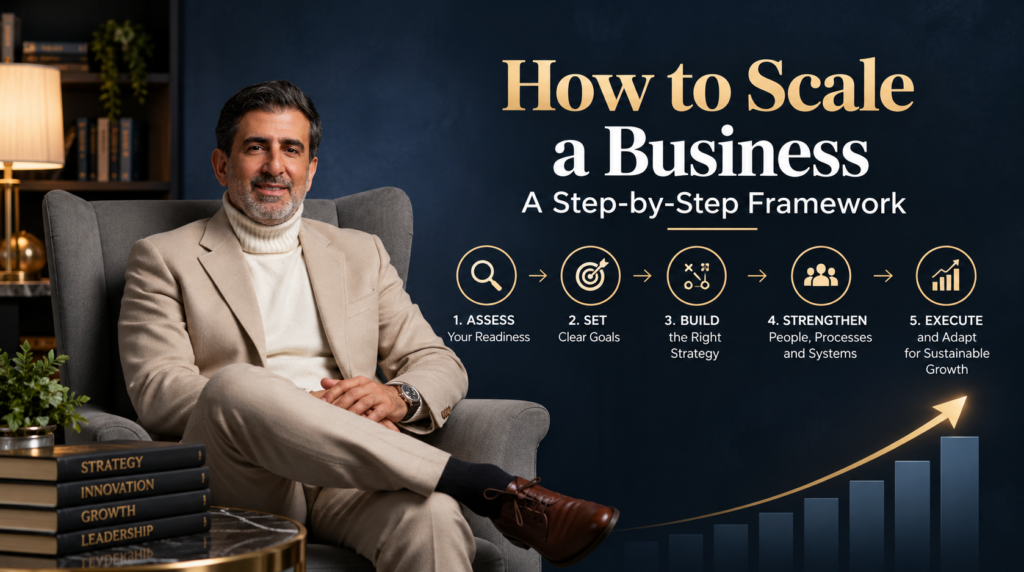
A practical seven-step scaling process for founders who want revenue to grow faster than costs, complexity, and dependence on themselves.
Samer Choucair, investment entrepreneur
Many companies grow. Far fewer scale. The difference shows up quietly: revenue doubles, but so do headcount, costs, customer complaints, and the founder’s working hours. On paper the business is bigger. In reality it has become heavier, more fragile, and more dependent on a few people holding everything together.
Learning how to scale a business means learning how to break that pattern, so that each additional customer, market, or product adds more value than it adds cost and complexity. It is one of the most important transitions a founder makes, and one of the most commonly mishandled, because the habits that build a company in its early years are often the habits that limit it later.
This guide, part of the Entrepreneurial Mindset series on the Samer Choucair platform, explains what scaling a business really means, the conditions that should be in place first, and a seven-step framework for the scaling process: from diagnosing your constraint and choosing a scaling model to building systems, leadership, capital, and the metrics that tell you whether scaling is working.
Key Takeaways
- Definition: Scaling a business means increasing revenue at a faster rate than costs and complexity, using repeatable systems rather than proportional increases in people and effort.
- Prerequisites first: Scale only what is proven: product-market fit, positive unit economics, a repeatable acquisition channel, documented operations, and enough cash to fund the transition.
- Start with the constraint: Every scaling effort should begin by identifying the single bottleneck limiting growth, whether demand, delivery, people, capital, or systems.
- Systems before headcount: Documented processes and the right technology let a business serve more customers without adding cost at the same rate.
- Measure leverage, not size: Contribution margin, customer acquisition cost relative to lifetime value, and revenue per employee reveal whether you are scaling or just growing.
In this article
- What Does It Mean to Scale a Business?
- Before You Scale: Five Prerequisites
- How to Scale a Business: The 7-Step Scaling Process
- Scaling a Business in the Gulf: Practical Considerations
- Common Mistakes When Scaling a Business
- The Metrics That Show Whether You Are Scaling
- Scaling Readiness Checklist
- Frequently Asked Questions
- Conclusion
What Does It Mean to Scale a Business?
Definition
To scale a business is to increase revenue and reach at a faster rate than the costs, resources, and complexity required to deliver them. A scalable business can serve significantly more customers without a proportional increase in people, overhead, or founder involvement, because its value is delivered through repeatable systems.
Scaling versus growing
Growth and scaling are often used interchangeably, but they describe different economics. A growing business adds resources at roughly the same rate it adds revenue. A scaling business adds revenue faster than resources, so margins and efficiency improve as it gets bigger.
| Dimension | Growing | Scaling |
|---|---|---|
| Revenue and costs | Rise together, roughly in proportion | Revenue rises faster than costs |
| Main driver | More people and more effort | Systems, technology, and leverage |
| Founder role | Involved in most decisions and deliveries | Focused on strategy, capital, and leadership |
| Margins over time | Flat or declining | Stable or improving |
| Example | A consultancy that hires one consultant for every new set of clients | A software company serving thousands of new users with the same core team |
Why scaling matters
Scalability shapes the long-term value of a company. Investors generally pay more attention to businesses that can expand without costs expanding at the same pace, because each new unit of revenue becomes more profitable. For founders, scaling is also what makes the business sustainable personally: a company that only grows through more of the founder’s time eventually hits a ceiling defined by that time.
|
Scale what works, fix what does not Scaling amplifies whatever exists. A strong model becomes stronger; a weak one fails faster and more expensively. |
The constraint sets the pace A business can only grow as fast as its tightest bottleneck allows. Find it before spending on anything else. |
|
Leverage is the goal The question is not how much more you can sell, but how much more you can sell for each additional unit of cost. |
People scale through systems Talented teams scale when they have clear processes, clear ownership, and the authority to decide. |
Before You Scale: Five Prerequisites
Scaling too early is one of the most expensive mistakes a young company can make, because it multiplies costs before the model is proven. Before committing to a scaling plan, five conditions should be clearly in place:
- Product-market fit: customers buy, return, and recommend you without unusual persuasion.
- Positive unit economics: each sale generates profit after direct costs and the cost of acquiring the customer.
- A repeatable acquisition channel: at least one channel brings in customers predictably at a known cost.
- Documented operations: core processes are written down and can be performed by someone other than the founder.
- Funding for the transition: cash or committed capital to cover the period when scaling costs arrive before scaling revenue.
Practical note
If one of these is missing, the right next step is usually to strengthen it within your current market rather than to expand. Scaling a business without positive unit economics simply multiplies the loss on every sale.
How to Scale a Business: The 7-Step Scaling Process
Once the prerequisites are in place, the scaling process follows a logical sequence. Each step builds the capacity the next one depends on.
| 01 |
Diagnose the constraint Identify the single bottleneck currently limiting growth. |
| 02 |
Choose the scaling model Decide where additional revenue will come from. |
| 03 |
Systemize operations Document and standardize how value is delivered. |
| 04 |
Automate with technology Remove manual work that grows with volume. |
| 05 |
Build the leadership layer Create a team that runs the business without the founder in every decision. |
| 06 |
Align capital with the plan Fund the scaling phase with the right type of money. |
| 07 |
Measure, iterate, and govern Track leverage metrics and adjust with discipline. |
Step 1: Diagnose your scaling constraint
Borrowing from the Theory of Constraints, a management approach associated with Eliyahu Goldratt, a system can only move as fast as its weakest link. In most scaling businesses, the constraint sits in one of five places:
- Demand: not enough qualified customers to fill existing capacity.
- Delivery: you cannot produce or serve more without quality dropping.
- People: key roles, often including the founder, are overloaded.
- Capital: cash flow cannot fund inventory, hiring, or expansion ahead of revenue.
- Systems: manual processes, scattered data, or unclear ownership slow everything down.
Investing anywhere other than the constraint produces little. Spending more on marketing when the real constraint is delivery capacity only creates longer waiting lists and unhappy customers.
Step 2: Choose your scaling model
There are several ways to scale a business, each with different capital needs and risk profiles. The right choice depends on where your proven strengths and your strongest demand signals are.
| Scaling model | How it works | Capital need | Typical risk |
|---|---|---|---|
| Deeper market penetration | More customers and more purchases in your current market | Low to medium | Low |
| New sales channels | E-commerce, distributors, or marketplaces reaching new buyers | Low to medium | Medium |
| Geographic expansion | Replicating the model in new cities or countries | High | Medium to high |
| Product extensions | Adding offers for the same customer base | Medium | Medium |
| Partnerships and licensing | Using partners’ reach or infrastructure | Low | Medium |
| Franchising | Partners fund and operate units under your system | Low for you | Brand and quality control risk |
Most businesses benefit from choosing one primary scaling model at a time. Pursuing several in parallel spreads leadership attention and capital too thin.
Step 3: Systemize operations
A business scales only to the extent that its way of delivering value can be repeated by others at consistent quality. That requires turning tacit knowledge into explicit systems:
- Standard operating procedures (SOPs) for the tasks that most affect customers and revenue.
- Playbooks for sales, onboarding, and customer service, so new team members ramp up quickly.
- Quality standards and checklists that make performance measurable rather than personal.
- Clear ownership: every recurring process has a named owner responsible for it.
A simple test: could a capable new hire deliver your core service at the expected standard after a short training period, using only your documentation and their manager? If not, this step comes before any expansion.
Step 4: Automate with technology
Technology is what allows revenue to rise without costs rising in step. The priority is to automate work that grows linearly with volume: order processing, invoicing, scheduling, reporting, and routine customer communication. A customer relationship management (CRM) system, integrated accounting and invoicing, and basic dashboards are often more valuable at this stage than ambitious custom software.
The common mistake is automating a broken process. Systemize first, then automate the process that already works.
Step 5: Build the leadership layer
In the early stages, the founder is the company’s operating system. Scaling requires replacing that dependence with a leadership layer: people who own functions, make decisions within clear limits, and develop their own teams.
- Identify the roles that unlock the constraint and hire for them first, often operations, sales leadership, or finance.
- Delegate decisions, not just tasks, with clear boundaries and accountability.
- Define a simple organizational structure so everyone knows who owns what.
- Protect the culture deliberately, because rapid hiring dilutes it faster than founders expect.
This is often the hardest step personally. The founder’s role shifts from doing and approving to setting direction, allocating capital, and developing leaders.
Step 6: Align capital with the scaling plan
Scaling usually requires investment before it produces returns: hiring ahead of demand, building systems, entering new markets, or carrying more inventory. The type of capital should match the risk and timeline of the plan.
| Funding option | Best suited for | Main trade-off |
|---|---|---|
| Retained earnings (bootstrapping) | Gradual scaling with strong margins | Slower pace, full ownership retained |
| Bank or asset-based financing | Predictable cash flows and tangible assets | Repayment obligations regardless of results |
| Strategic partners | Access to distribution, markets, or infrastructure | Shared control or economics |
| Equity investment | Fast scaling in large markets with high potential | Dilution and investor expectations |
From an investor’s perspective, the strongest case for scaling capital is a model already proven at small scale, with clear evidence of how additional capital translates into additional profitable revenue.
Step 7: Measure, iterate, and govern
Scaling is not a single decision but a series of experiments. Each expansion should start with defined success criteria, defined stop criteria, and a timeline. Review leverage metrics monthly, and make one of three explicit decisions for each initiative: continue, adjust, or stop. As the company grows, introduce governance appropriate to its size, such as regular management reporting, budget ownership, and, where relevant, an advisory board.
Editorial Insight
Scaling does not fix a business. It magnifies it. Make sure what you are magnifying is worth multiplying.
Scaling a Business in the Gulf: Practical Considerations
Founders scaling in Saudi Arabia and the wider GCC operate in markets undergoing rapid economic diversification, which creates real opportunities in sectors such as technology, tourism, logistics, and services. A few considerations deserve particular attention:
- Each GCC country has its own licensing, commercial registration, and tax framework. Expanding across borders means rebuilding parts of your compliance setup, not just opening a new office.
- Workforce localization requirements differ by country and sector, and affect hiring plans and costs. Verify current requirements with official sources before building a headcount plan.
- Relationships and trust carry significant weight in B2B markets across the region, so local partners and senior local hires can shorten the path to scale.
- Customer expectations and purchasing behavior vary between markets that look similar from the outside. Test with a light presence before committing to full infrastructure.
Important
Regulations, fees, and thresholds in the region are updated regularly. Treat any specific requirement as something to confirm with the relevant government authority or a qualified local advisor at the time of expansion.
Common Mistakes When Scaling a Business
| ✕ |
Scaling before the model is provenExpanding on the strength of a few good months, a seasonal spike, or available funding rather than stable, profitable demand. |
| ✕ |
Hiring faster than systems can absorbNew people without documented processes and clear ownership create confusion, inconsistent quality, and rising costs. |
| ✕ |
Remaining the bottleneckFounders who keep every major decision for themselves cap the company at their own capacity, however large the team becomes. |
| ✕ |
Pursuing several scaling models at onceNew markets, new products, and new channels launched together dilute capital and leadership attention. |
| ✕ |
Ignoring cash flow during expansionProfitable growth can still run out of cash when inventory, receivables, and hiring costs arrive before revenue. |
| ✕ |
Neglecting the core businessLeadership attention moves to the new initiative, and the original business, which funds everything, quietly weakens. |
The Metrics That Show Whether You Are Scaling
Size alone does not prove scaling. These metrics reveal whether the business is gaining leverage as it grows:
| Metric | What it shows | Healthy scaling signal |
|---|---|---|
| Revenue growth rate | How fast the business is expanding | Sustained growth outside seasonal peaks |
| Contribution margin | Profit per sale after variable costs | Stable or improving as volume rises |
| CAC to LTV relationship | Cost of acquiring a customer versus their lifetime value | Lifetime value clearly exceeds acquisition cost |
| Revenue per employee | Productivity of the organization | Rising over time |
| Operating margin | Overall efficiency after fixed costs | Improving as the business grows |
| Cash runway | Months of operation funded by current cash | Sufficient to complete the current scaling phase |
Scaling Readiness Checklist
- ☐Customers return and refer others without heavy incentives.
- ☐Every sale is profitable after direct and acquisition costs.
- ☐At least one acquisition channel performs predictably.
- ☐Core processes are documented and owned by named people.
- ☐The business runs for a week without the founder’s daily involvement.
- ☐The current scaling constraint has been clearly identified.
- ☐One primary scaling model has been chosen.
- ☐Funding covers the transition under a conservative scenario.
- ☐Success and stop criteria are written down with a timeline.
Frequently Asked Questions About Scaling a Business
How do you scale a business?
To scale a business, first confirm product-market fit and positive unit economics, then follow a structured scaling process: diagnose the constraint limiting growth, choose one scaling model, systemize and automate operations, build a leadership team, secure appropriate capital, and measure leverage metrics such as contribution margin and revenue per employee.
What is the difference between growing and scaling a business?
Growing means revenue and costs rise at a similar rate. Scaling means revenue rises faster than costs, so efficiency and margins improve as the business expands. Scaling relies on systems and technology rather than proportional increases in people and effort.
When is the right time to scale a business?
The right time is when demand consistently exceeds capacity, each sale is profitable, at least one acquisition channel is predictable, operations are documented, and you have enough cash or committed capital to fund the transition period before new revenue arrives.
What are the biggest challenges in scaling a business?
The most common challenges are cash flow pressure during expansion, maintaining quality as volume increases, hiring and developing leaders quickly enough, preserving company culture, and the founder’s own transition from operator to leader.
Do you need outside funding to scale a business?
Not always. Many businesses scale gradually from retained earnings, especially those with strong margins. Outside funding becomes useful when a proven model needs capital to expand faster, and the type of funding should match the risk and timeline of the plan.
Which metrics matter most when scaling?
The most useful scaling metrics measure leverage rather than size: contribution margin, the relationship between customer acquisition cost and lifetime value, revenue per employee, operating margin, and cash runway.
Can every business be scaled?
Most businesses can scale to some degree, but not all equally. Models that depend heavily on a specific individual’s time or highly customized work are harder to scale. Productizing services, standardizing delivery, and using technology can significantly increase scalability.
Conclusion
Knowing how to scale a business comes down to a disciplined sequence: prove the model, find the constraint, choose one path, build systems and leaders that replace dependence on the founder, fund the transition wisely, and measure leverage rather than size.
Approached this way, scaling a business stops being a leap of faith and becomes a series of deliberate, measurable decisions. The result is not just a bigger company, but a more valuable one: more efficient, less fragile, and better positioned to attract investment and leadership talent for the next stage of growth.
Samer Choucair
Entrepreneur and investor writing about entrepreneurship, investment, strategic thinking, and business growth in the Arab world.