
Critical Thinking for Entrepreneurs: How to Think Clearly
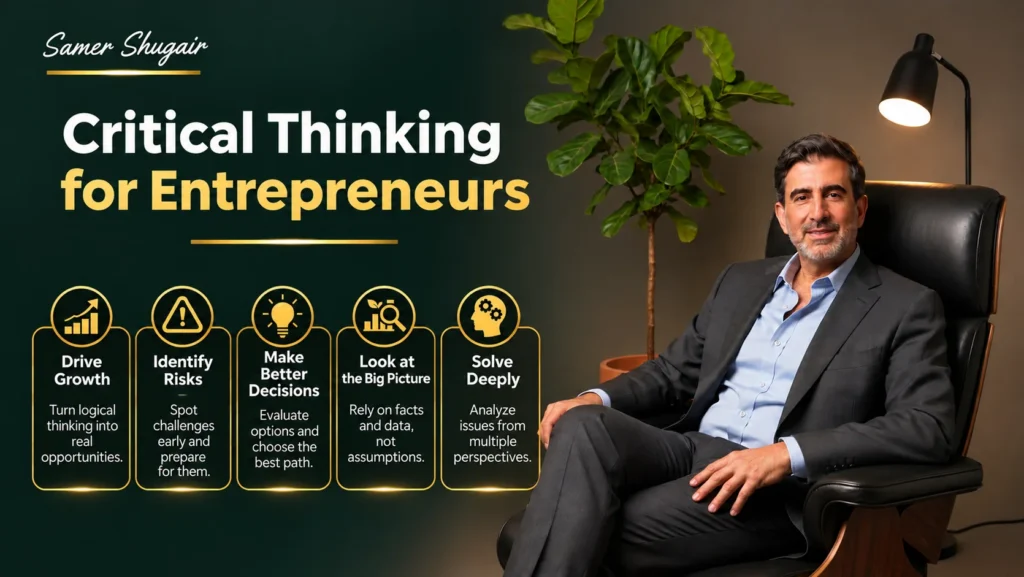
Entrepreneurial Mindset
A complete guide to critical thinking for entrepreneurs: what it is, why it determines the quality of your decisions, the six skills it rests on, the biases that fool even the smartest founders, plus practical tools and a thirty-day training plan.
Samer Choucair, investment entrepreneur
In a single day, an entrepreneur makes more decisions than many employees make in a month: which idea to develop, which customer to target, what price to charge, whom to hire, when to expand, and when to stop. Every one of these decisions rests on one basic question: am I thinking clearly, or are my enthusiasm, my fears, or my first impressions deciding for me?
This is where critical thinking for entrepreneurs comes in. It is not an academic skill taught in philosophy classrooms, but an everyday tool that separates the business that learns from reality and adapts, from the business that builds on untested assumptions until it collides with the market.
In this guide, on the Samer Choucair platform, we explain critical thinking for entrepreneurs in practical terms: its definition, its importance, the skills it is made of, the biases that block it, and the tools that help apply it to real decisions, followed by a training plan you can start today.
Key Takeaways
- Thinking before enthusiasm: Critical thinking for entrepreneurs tests an idea before money and time are invested in it.
- Six core skills: Interpretation, analysis, evaluation, inference, explanation, and self regulation.
- Biases are a hidden enemy: Confirmation bias, sunk cost, and overconfidence fool even the smartest founders.
- Practical tools: The five whys, first principles thinking, the pre mortem, and inversion.
- A skill built by practice: Critical thinking for entrepreneurs is a habit developed through daily practice, not a talent some are born with.
Table of Contents
- What Is Critical Thinking for Entrepreneurs?
- Why Does Critical Thinking Matter for Entrepreneurs?
- What Are the Core Critical Thinking Skills in Business?
- Which Biases Block Critical Thinking?
- What Are the Most Practical Critical Thinking Tools?
- How Do You Apply Critical Thinking to Business Decisions?
- How Can You Improve Your Critical Thinking in 30 Days?
- What Are Common Critical Thinking Mistakes?
- Frequently Asked Questions
- Conclusion
What Is Critical Thinking for Entrepreneurs?
Short Answer
Critical thinking for entrepreneurs is the ability to examine ideas, information, and assumptions systematically before making a decision: asking the right questions, separating fact from opinion, weighing evidence, watching for personal biases, and reaching a decision based on the best possible understanding of reality.
Critical thinking does not mean criticism, pessimism, or rejecting every new idea. It means treating ideas, including your own, as hypotheses to be tested rather than facts to be accepted. The difference between critical thinking for entrepreneurs and critical thinking in general is that founders apply it under time pressure, with limited resources and high uncertainty, and the cost of being wrong comes out of their own money, time, and team.
The essence of critical thinking for entrepreneurs can be summed up in three simple questions an entrepreneur asks of every idea or piece of information: What is the evidence? What could make me wrong? And what alternatives have I not considered yet?
| Fast Thinking | Critical Thinking |
|---|---|
| Accepts the first piece of information | Asks about its source and evidence |
| Looks for what confirms its view | Looks for what might disprove it |
| Judges from personal experience | Compares with data and other experiences |
| Clings to the previous decision | Revisits the decision when the facts change |
| Sees only two options | Looks for a third and fourth option |
Why Does Critical Thinking Matter for Entrepreneurs?
Short Answer
Because entrepreneurs make many decisions in an uncertain environment with limited resources. Critical thinking for entrepreneurs reduces costly mistakes, exposes wrong assumptions early, and improves the quality of decisions on pricing, hiring, expansion, and funding.
Many ventures begin with great enthusiasm and an idea its founder considers brilliant. But enthusiasm alone does not test an idea. This is the value of critical thinking for entrepreneurs: it pushes the founder to ask before building, to test before scaling, and to read the numbers before believing impressions.
The importance of critical thinking for entrepreneurs shows up in situations that repeat every day:
- When a few friends say the idea is great, does that mean the market will pay for it?
- When sales rise in a single month, is that a real trend or a seasonal event?
- When a candidate performs impressively in an interview, does that reflect their actual ability on the job?
- When an adviser suggests a strategy that worked at another company, are that company’s conditions similar to yours?
- When a product’s performance declines, is the problem the product, the marketing, or the timing?
In every one of these situations, critical thinking for entrepreneurs makes the difference between a decision based on an accurate reading of reality and a decision based on what the founder wishes were true. It is one of the pillars of an entrepreneurial mindset, which combines boldness in taking initiative with discipline in thinking.
What Are the Core Critical Thinking Skills in Business?
Short Answer
Critical thinking rests on six core skills: interpretation, analysis, evaluation, inference, explanation, and self regulation. They were defined in the Delphi Report published by the American Philosophical Association in 1990, led by Peter Facione.
One of the best known frameworks defining the components of critical thinking is the Delphi Report, developed by a panel of experts led by researcher Peter Facione and published in 1990. Here are its six skills, translated into everyday critical thinking skills in business:
|
Interpretation Understanding information as it is: what a customer is actually saying in a complaint, not what we assume they mean. |
Analysis Breaking a problem into its parts: are profits down because of sales, costs, or pricing? |
|
Evaluation Judging the credibility of a source and the strength of evidence: is this study truly representative of your market? |
Inference Reaching logical conclusions from the available evidence, while recognising its limits. |
|
Explanation Presenting the reasoning behind a decision clearly to your team, investors, or partners. |
Self regulation Monitoring your own thinking, reviewing your decisions, and being ready to change your mind when the evidence changes. |
Of these skills, self regulation remains the hardest and most important in critical thinking for entrepreneurs. It is easy to criticise other people’s ideas, but hard to question your own, especially when you have invested your money, time, and reputation in them.
Which Biases Block Critical Thinking?
Short Answer
The main biases that block critical thinking for entrepreneurs are confirmation bias, the sunk cost fallacy, overconfidence, survivorship bias, and anchoring. All are automatic thinking patterns that lead to wrong decisions without the person noticing.
Cognitive biases are automatic thinking patterns everyone falls into, documented by psychologists Daniel Kahneman and Amos Tversky in their research. Being smart is not enough to avoid them; you need to know them by name and look for them in your own decisions. That is why understanding cognitive biases is a core part of critical thinking for entrepreneurs.
| ✕ |
Confirmation biasSeeking information that confirms what you already believe and ignoring what contradicts it, such as asking only the customers who loved your product. |
| ✕ |
Sunk cost fallacyContinuing a losing project or product because you have spent a lot on it, even though what was spent cannot be recovered either way. |
| ✕ |
OverconfidenceOverestimating your abilities or chances of success, which leads to unrealistic plans and optimistic time and budget estimates. |
| ✕ |
Survivorship biasStudying only successful companies and inferring the reasons for their success, without looking at the companies that did the same things and failed. |
| ✕ |
AnchoringFixating on the first number or piece of information you hear, such as your company’s first valuation or the first price you propose, and building every later decision on it. |
These biases multiply when an entrepreneur is tired or under pressure. Protecting decision quality starts with protecting mental energy, as the article on how to avoid decision fatigue as an entrepreneur explains. Some of these biases are also fed by popular beliefs about entrepreneurship, which the article on entrepreneurial mindset myths takes apart.
What Are the Most Practical Critical Thinking Tools?
Short Answer
Among the most useful critical thinking tools are the five whys to find the root of a problem, first principles thinking to rebuild solutions, the pre mortem to expose risks, inversion, and second order thinking to anticipate indirect consequences.
Theory is not enough; critical thinking for entrepreneurs needs tools that can be used in real meetings and decisions. Here are five proven tools:
1. The Five Whys
A tool associated with the Toyota Production System, built on asking “why?” five times in a row to reach the root of a problem instead of treating its symptoms. If sales drop, do not stop at “because customers decreased”; ask why they decreased, then why again, until you reach a cause you can actually fix.
2. First Principles Thinking
Instead of building on what competitors do or what the market is used to, break the problem down to its basic truths and rebuild the solution from there. Ask: what do we know for certain here? And what are we assuming only because everyone else does it?
3. The Pre Mortem
A method proposed by researcher Gary Klein: before launching a project or product, imagine with your team that it has failed a year from now, then write down every possible reason for that failure. The exercise exposes risks that enthusiasm hides and gives team members a safe space to voice their concerns.
4. Inversion
Instead of asking “how do I succeed?”, ask “what would guarantee failure?” and then avoid it. Charlie Munger, Warren Buffett’s partner, was well known for advocating this kind of thinking. Sometimes avoiding big mistakes is easier and more useful than searching for the brilliant move.
5. Second Order Thinking
Most people think about the direct result of a decision. Second order thinking asks: and then what? Cutting prices may raise sales today, but it may also change how your brand is perceived, attract less loyal customers, and push competitors into a price war. This kind of thinking is a core part of critical thinking for entrepreneurs in strategic decisions.
| Tool | When to Use It | Core Question |
|---|---|---|
| Five whys | When a problem keeps recurring | Why did this really happen? |
| First principles | When designing a product or business model | What are the basic truths here? |
| Pre mortem | Before a launch or major decision | Why might we fail? |
| Inversion | When setting strategy | What would guarantee failure? |
| Second order thinking | For pricing and expansion decisions | And then what? |
How Do You Apply Critical Thinking to Business Decisions?
The real value of critical thinking for entrepreneurs appears when it moves from concept to practice in everyday decisions. Here is what that looks like in the most important areas of a business:
Validating the Idea
Instead of asking the people around you “do you like the idea?”, ask potential customers about the problem they face, how they solve it today, and how much they pay for that. Liking an idea does not mean being willing to pay for it, and that gap is the first thing critical thinking for entrepreneurs reveals.
Reading Data
Always ask about context: compared with what? Over what period? What is the sample size? A 50% rise in sales may look like an achievement, but it means something very different if it went from 10 sales to 15, or from 1,000 to 1,500. Reading numbers in context is one of the simplest and most powerful applications of critical thinking for entrepreneurs.
Hiring
Do not judge by first impressions or by how similar a candidate is to you. Ask for real examples from their experience, assess skills with practical tasks, and ask more than one person on the team for their view before deciding. Hiring is one of the situations where critical thinking for entrepreneurs is tested most.
Handling Advice and Relationships
Advice from consultants, investors, and mentors is valuable, but it is not an order. Ask about the conditions in which the advice worked, and compare them with yours. Building a diverse network gives you multiple perspectives to test your ideas against, as the article on networking tips for entrepreneurs who hate networking explains.
In all these areas, a clear method helps you apply critical thinking for entrepreneurs consistently rather than at random, and the article on business decision making frameworks offers practical frameworks that complement the tools above.
Editorial Insight
A successful entrepreneur is not someone who never makes mistakes, but someone who discovers a mistake before it becomes expensive.
How Can You Improve Your Critical Thinking in 30 Days?
Short Answer
You can develop critical thinking for entrepreneurs with a four stage plan: one week to become aware of biases, one week to apply the core questions, one week to try the practical tools, and one week to review decisions and record lessons.
Critical thinking for entrepreneurs is a skill that does not develop through reading alone, but through repeated practice. Here is a simple thirty day plan:
| 01 |
Week 1: Awareness Learn the five biases above, and each day look for one example of them in your decisions or in the decisions of people around you. |
| 02 |
Week 2: Questions Before every important decision, write down answers to three questions: What is the evidence? What could make me wrong? What are the alternatives? |
| 03 |
Week 3: Tools Try at least one of the five tools on a real problem in your business, and discuss the result with your team. |
| 04 |
Week 4: Review Review the month’s decisions: what did you expect? What actually happened? What lesson will you apply next time? |
This plan needs dedicated time in your calendar, not whatever is left of the day. The article on time management for entrepreneurs offers strategies to protect time for deep thinking from the rush of daily tasks.
- ☐Do I ask for evidence before believing important information?
- ☐Do I look for views that contradict my own?
- ☐Do I review my past decisions and learn from them?
- ☐Do I use a structured tool for major decisions?
- ☐Am I ready to change my mind when the evidence changes?
What Are Common Critical Thinking Mistakes?
Just as the absence of critical thinking is a problem, applying it the wrong way is a problem too. Common mistakes in critical thinking for entrepreneurs include:
- Analysis paralysis: gathering information endlessly and postponing the decision in search of complete certainty.
- Destructive criticism: using critical thinking to shoot down other people’s ideas instead of improving them, which kills initiative in the team.
- Selective scepticism: applying critical thinking only to ideas you dislike, and exempting your favourite ideas from it.
- Ignoring intuition entirely: intuition built on long experience has value; the goal is to test it, not discard it.
The balance you need is to think deeply enough to avoid big mistakes, then move fast enough to seize opportunities. And when you are wrong despite all this, which will happen, entrepreneurial resilience is what helps you learn and recover. Many of the mistakes founders make in the early stages come down to missing critical thinking for entrepreneurs.
In the Saudi and Gulf context, as entrepreneurship expands under Vision 2030 and competition grows in new sectors, critical thinking skills in business become a real competitive advantage. A fast growing market attracts many ideas, but the businesses that last are usually the ones that tested their assumptions early and learned from data rather than impressions. That is the practical payoff of critical thinking for entrepreneurs.
Sources
Peter A. Facione, Critical Thinking: A Statement of Expert Consensus (the Delphi Report, American Philosophical Association, 1990); Daniel Kahneman, Thinking, Fast and Slow (2011); Gary Klein, Performing a Project Premortem, Harvard Business Review (2007); the Toyota Production System and the five whys method; Charlie Munger’s ideas on inversion.
Frequently Asked Questions
What is critical thinking for entrepreneurs?
The ability to examine ideas, information, and assumptions systematically before making a decision, to separate fact from opinion, and to watch for personal biases.
Why do entrepreneurs need critical thinking?
Because they make many decisions in an uncertain environment with limited resources, and critical thinking for entrepreneurs reduces costly mistakes and exposes wrong assumptions early.
What are the core critical thinking skills in business?
Interpretation, analysis, evaluation, inference, explanation, and self-regulation, according to the 1990 Delphi Report.
Which biases block critical thinking most?
Confirmation bias, the sunk cost fallacy, overconfidence, survivorship bias, and anchoring.
What is the easiest critical thinking tool to start with?
The five whys: ask “why?” five times in a row about any problem to reach its root cause instead of treating its symptoms.
Does critical thinking mean being negative or rejecting ideas?
No. Critical thinking means testing ideas, including your own, not rejecting them. The goal is better decisions, not less initiative.
How can I improve critical thinking for entrepreneurs?
Through regular practice: learn the main biases, ask the core questions before every important decision, try the practical tools, and review your past decisions.
Does critical thinking for entrepreneurs slow down decision making?
Not necessarily. The goal is balance: enough thinking to avoid big mistakes, and enough speed to seize opportunities, while avoiding analysis paralysis.
Conclusion
Critical thinking for entrepreneurs is not an intellectual luxury; it is a survival tool in a fast changing environment. It protects founders from both their overenthusiasm and their fears, and helps them see reality as it is rather than as they wish it were. With the six skills, awareness of biases, practical tools, and a training plan, any entrepreneur can build this skill step by step.
Which bias do you notice most in your decisions? And which tool will you try this week? Share your experience, and follow the Samer Choucair platform for more practical guides on entrepreneurship and investing.
Samer Choucair
Entrepreneur and investor writing about entrepreneurship, investment, strategic thinking, and business growth in the Arab world.