
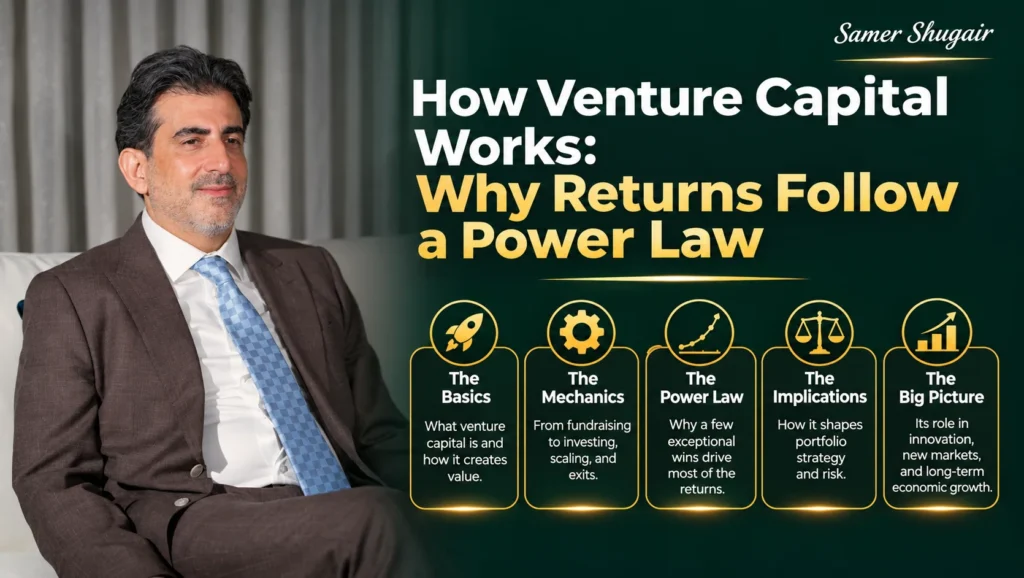
How Venture Capital Works: Why Returns Follow a Power Law
Vision 2030
Samer Choucair’s reading of how venture capital works: how funds raise money and invest it in startups, why most returns come from a handful of deals, with examples from Nvidia, Canva, and Shopify, and the model’s limits and risks in the context of Vision 2030.
Samer Choucair, investment entrepreneur
In my content on Vision 2030 and startup funding, followed by a wide audience, I explain that venture capital is not just “money for early investors”. It is a model that funds high growth companies in exchange for equity, with the expectation that most investments will not succeed while a few generate most of the return. This differs from traditional investing in listed stocks, where outcomes are closer to a normal distribution; here returns usually follow a power law: a small share of deals produces the vast majority of a fund’s profits.
Funds raise money from institutional investors (pension funds, endowments, wealthy families) and then invest it at early stages: seed, when an idea or early product exists, then later rounds (Series A and beyond) when signs of growth appear. The VC investor is not looking for a steady return; they are looking for companies that could grow many times over if they succeed. In exchange, they accept that a large share of the portfolio may go to zero or return little.
In this article, on the Samer Choucair platform, we explain how venture capital works step by step, why its returns follow a power law, and what investors watch before deciding. We then look at practical examples of early bets that held up, the model’s limits and risks, and what it all means for founders and investors in Saudi Arabia.
Key Takeaways
- Equity for growth: The model funds high growth companies in exchange for equity, not a fixed interest payment.
- The few make the most: Under a power law, a small share of deals produces the vast majority of a fund’s profits.
- Team before plan: At early stages, the team’s ability to learn and adapt is weighed more than precise financial forecasts.
- Real demand is a stronger signal: Paying or regular users count for more than interest or a promising sector narrative.
- Not for every investor: Low liquidity, a long horizon, and the possibility of total loss in a large share of deals.
Table of Contents
- What Is Venture Capital?
- How Does Venture Capital Work Step by Step?
- Why Do Venture Capital Returns Follow a Power Law?
- What Does a VC Investor Actually Watch?
- What Are Practical Examples of Early Bets That Held Up?
- What Makes a Bet Hold Up?
- What Are the Model’s Limits and Risks?
- Venture Capital in Saudi Arabia and Vision 2030
- Frequently Asked Questions
- Conclusion
What Is Venture Capital?
Short Answer
Venture capital is an investment model in which specialised funds finance high growth startups in exchange for equity, expecting most investments to fail or return little while a few succeed so strongly that they cover the losses and generate most of the fund’s profits.
Venture capital differs from bank loans, which expect repayment with fixed interest, and from investing in listed stocks, which relies on established companies with clear financial records. Here the investor enters at a stage when the company has not yet proven its business model, accepting high risk in exchange for the chance of exceptional growth.
That is why venture capital is usually tied to sectors that can scale quickly, such as technology, digital services, and fintech, where a single product can serve millions of customers without costs rising at the same rate.
How Does Venture Capital Work Step by Step?
Short Answer
A fund raises money from institutional investors, invests it in startups across successive funding rounds starting with seed, helps the companies grow, and realises its return when it exits through an acquisition or IPO years later.
The venture capital cycle can be simplified into four main stages:
| 01 |
Raising the fund Fund managers raise capital from institutional investors such as pension funds, endowments, and wealthy families. |
| 02 |
Investing in companies The fund selects a number of startups and invests in them in exchange for equity, usually in stages. |
| 03 |
Supporting growth Alongside money, the fund provides networks, expertise, and strategic guidance, and joins later rounds for promising companies. |
| 04 |
Exit and return The return comes when the stake is sold, through an acquisition by a larger company or a public listing, often after seven to ten years or more. |
A startup typically goes through several funding rounds, which differ in size, risk, and what the investor looks for in each:
| Stage | Company Status | What the Investor Looks For |
|---|---|---|
| Seed | An idea or early product exists | The team, the size of the problem, and first signs of demand |
| Series A | A working product and early growth signals | A repeatable business model and real demand |
| Series B and beyond | Clear growth and market expansion | The ability to scale efficiently and improve margins |
| Exit | A mature company | An acquisition or IPO that realises the return |
With each new round, the ownership share of founders and early investors falls, which is known as dilution. That is why a VC investor cares that founders keep enough incentive to continue even after multiple rounds.
Why Do Venture Capital Returns Follow a Power Law?
Morgan Housel, in The Psychology of Money, describes how big results in some fields come from a small number of winning bets surviving for a long time, while the rest disappear. In venture capital this shows clearly: a fund may invest in twenty or thirty companies, and two or three succeed so strongly that they cover the losses of the rest and generate the target return. Daniel Kahneman notes that making decisions under high uncertainty exposes us to biases; here the VC investor tries to reduce them by examining the team, the market size, and the ability to execute, but cannot remove the uncertainty.
Short Answer
A power law means outcomes are not evenly distributed; a very small number of investments produce most of the return. In venture capital, one or two successful companies can cover the losses of the entire portfolio and generate most of the fund’s profits.
To illustrate with a simplified, hypothetical example: if a fund invested equal amounts in twenty companies, most might lose their full value or return little, while one company grows so many times over that it alone covers all the losses and delivers a profit for the fund. The example is for illustration only, but it explains why a VC investor is not looking for the “safe” deal, but for the deal that could become exceptional.
| Listed Stocks | Venture capital |
|---|---|
| Returns closer to a normal distribution | Returns follow a power law |
| Established companies and clear records | Early stage companies and little information |
| High liquidity, can sell any time | Low liquidity and a long horizon |
| Total loss relatively rare | Total loss possible in a large share of deals |
| Aim: a reasonable, stable return | Aim: a few exceptional successes |
In the context of Vision 2030, as local and regional venture capital funds expand to finance technology and digital services, the principle stays the same: a fund’s overall return depends on a few big successes, not on an equal average across every deal. This explains why some investors focus on the potential market size and the team’s ability to adapt more than on precise financial forecasts at early stages.
What Does a VC Investor Actually Watch?
Short Answer
A VC investor watches four core elements: the size of the problem the company solves, the team’s ability to learn and adjust, signals of real demand, and an ownership structure that keeps founders motivated.
- The size of the problem the company solves and how many people suffer from it.
- The team’s ability to learn from rejection or early failure and adjust the product.
- Signals of real demand (users who pay or use the product regularly), not just interest.
- The ownership structure and future dilution, so founders keep enough incentive.
For a founder thinking about approaching venture capital funds, these four elements form a practical preparation checklist: can you prove the size of the problem? Do you have evidence of real demand? Has your team shown it can learn? The article on how to become an entrepreneur is a starting point for anyone building their first business.
What Are Practical Examples of Early Bets That Held Up?
When I review the stories of companies that built great value, I go back to the moment a VC investor accepted the risk despite an unclear outcome. In Nvidia’s case, early funding came from firms such as Sequoia after the company was founded in 1993, at a time when graphics chips were an emerging market full of fierce competition and technical failure. The company nearly went bankrupt more than once before its later products succeeded. The investor who came in early endured years of uncertainty.
In Canva’s story, more than a hundred investors turned down the idea before it secured seed funding in 2013. The rejection was not always about a weak idea; much of it related to geography, the team’s inexperience, or the perceived market size at the time. Those who eventually said yes bet that simplifying design for non professionals solved a broad problem, and that the team had proven its ability to persist despite rejection. At Shopify, early funding came from a close circle and then from investors after the product showed demand from real merchants, not just a theoretical plan.
| Company | Early Challenge | What the Investor Bet On |
|---|---|---|
| Nvidia | An emerging market, fierce competition, and technical failure | The team’s ability to survive until products succeeded |
| Canva | Rejected by more than a hundred investors | The size of the problem and the team’s persistence |
| Shopify | A product that started as an internal tool | Real demand from merchants using the product |
The three examples meet at one idea: venture capital does not bet on a finished company, but on a team able to survive and learn until the opportunity becomes clear. That is why founders’ resilience in the face of rejection and crisis is decisive, as the article on entrepreneurial resilience explains.
What Makes a Bet Hold Up?
Howard Marks, in his writing on risk, explains that good returns often come from accepting risk that others misprice. At early stages, information is scarce and outcomes are far away. The VC investor tries to assess whether the team can change course when the first hypothesis fails, and whether the market is large enough to justify repeated dilution of ownership. Benjamin Graham focused on the margin of safety in assets that can be valued; in venture capital a different “margin” appears: the ability to bear that most bets will not succeed, provided the potential success of the few is large enough.
In Gulf markets under Vision 2030, local and regional funds have begun financing companies in fintech, ecommerce, and digital services. The lesson from global examples is that early funding works better when there is evidence of real demand or clear execution capability, not when it relies only on the narrative of a promising sector. And a founder who learns from rejection and adjusts the product sends a stronger signal than one who insists on the original plan despite no usage.
Editorial Insight
In venture capital, the winner is not the one who avoids every loss, but the one who can absorb many small losses until finding the few big wins.
What Are the Model’s Limits and Risks?
I do not consider the model suitable for every investor. Liquidity is low, the horizon is long (often seven to ten years or more), and total loss is possible in a large share of deals. Anyone entering this field must understand that returns come from an uneven distribution, not from expecting most companies to succeed.
Venture capital does not suit every company. Companies that grow slowly or need heavy capital without high scalability may not find suitable funding, or may find funding that forces growth faster than their operations can handle. High valuations during periods of enthusiasm can also reduce future returns even if the company succeeds operationally. An institutional investor allocating to venture capital should look at a fund’s record across different cycles, not at a single successful deal.
| ✕ |
For investors: expecting most deals to succeedEntering with the expectation that most companies will succeed contradicts the nature of a model built on a power law. |
| ✕ |
For investors: judging by one dealAssessing a fund on the basis of one success, without looking at its record across different cycles. |
| ✕ |
For founders: funding that does not fit the businessAccepting funding that forces faster growth than operations can bear, in a business without high scalability. |
That is why founders need to ask themselves honestly before seeking venture capital: can my business scale at the speed a VC investor expects? The article on how to scale a business helps assess that readiness, while the article on business decision making frameworks offers tools to make the funding decision systematically.
Venture Capital in Saudi Arabia and Vision 2030
In recent years the Kingdom has seen notable growth in its venture capital ecosystem, with a role for government bodies such as Saudi Venture Capital Company (SVC), established in 2018 to stimulate investment in startups, and the Small and Medium Enterprises General Authority, Monsha’at. This direction aligns with Vision 2030 goals of diversifying the economy and supporting innovation and entrepreneurship.
For Saudi investors, this means opportunities in this field have widened, whether through specialised funds or angel investing. But it also means understanding the model before entering: low liquidity, a long horizon, and returns that depend on a few successes. For founders, the most important lesson is that early funding comes faster with evidence of real demand, not just a promising sector narrative. That is the practical reality of venture capital in a fast growing market.
Disclaimer
This article is for general awareness and is not investment advice. Venture investing is high risk and can result in the loss of the full amount invested. Every investor has different circumstances, goals, and risk tolerance. Consult a licensed professional and verify regulations with the Capital Market Authority before making any decision.
Sources
The structure of venture capital funds and common funding stages; observations on return distribution (the power law); Nvidia’s early funding and its operating record in the 1990s; Canva’s repeated rejection and its 2013 funding; Shopify’s path from an internal product to a funded platform; principles from Housel on uneven outcomes, Kahneman on decisions under uncertainty, Marks on pricing risk, and Graham on the margin of safety; Saudi Venture Capital Company.
Frequently Asked Questions
What is venture capital?
A model in which specialised funds finance high growth startups in exchange for equity, expecting most investments to fail while a few generate most of the return.
What does a power law mean in investing?
That returns are not evenly distributed; a small share of deals produces the vast majority of the profits.
What are the stages of funding rounds?
It starts with a seed round when an idea or early product exists, then Series A when growth signals appear, then later rounds, up to an exit through an acquisition or IPO.
What does a VC investor look for?
The size of the problem, the team’s ability to learn and adjust, signals of real demand, and an ownership structure that keeps founders motivated.
Is venture capital suitable for every investor?
No. Liquidity is low, the horizon often runs seven to ten years or more, and total loss is possible in a large share of deals.
Does this kind of funding suit every startup?
No. Companies that grow slowly or need heavy capital without high scalability may not be a good fit.
Why was Canva rejected by more than a hundred investors?
Much of the rejection related to geography, the team’s inexperience, or the perceived market size at the time, not always to a weak idea.
Conclusion
Venture capital is neither easy money nor a safe investment; it is a model built on a deep understanding of the power law: many small losses, and a few big wins that create most of the return. Whoever understands this logic, investor or founder, approaches the model with realistic expectations and clearer decisions.
Do you think the power law in returns makes venture capital suitable for part of your portfolio, or do you prefer more balanced models? And which example is closest to how you assess startups today? Share your view, and follow Samer Choucair’s analysis of growth funding in emerging markets.
Samer Choucair
Entrepreneur and investor writing about entrepreneurship, investment, strategic thinking, and business growth in the Arab world.