
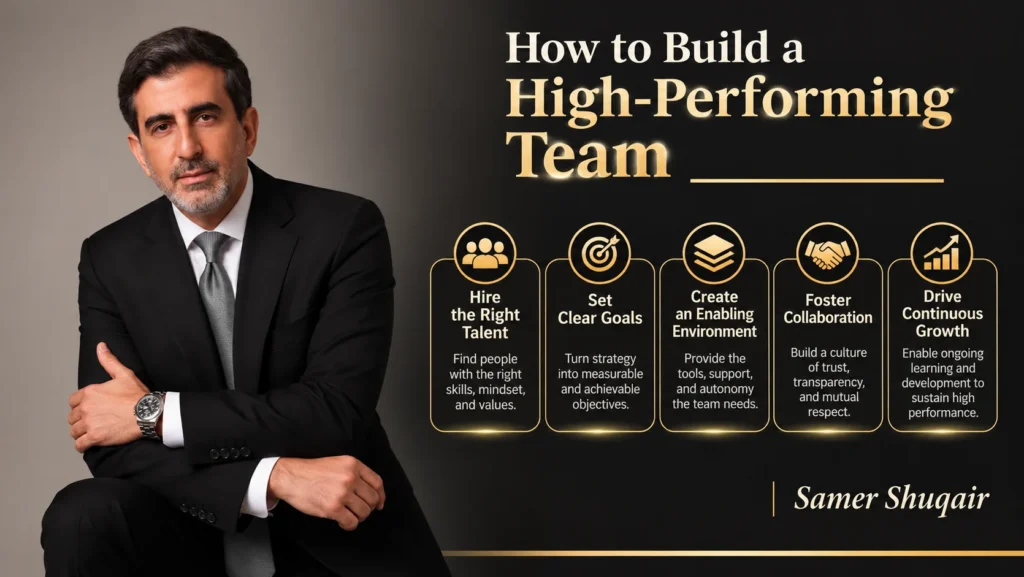
How to Build a High-Performing Team
Leadership
A high-performing team does not form by chance, and it is not built simply by hiring the best talent. A practical guide to how to build a high-performing team, from choosing people and clarifying roles to psychological safety, accountability, and delegation, with common mistakes and a step by step plan.
Samer Choucair, investment entrepreneur
Every successful venture starts with an idea, but it only grows through a team. The entrepreneur who tries to do everything alone soon hits a ceiling, and the company with an excellent product and a weak team often loses to a company with an ordinary product and a cohesive team.
Yet the question of how to build a high-performing team is one of the most misunderstood questions in business. Many people assume the answer is to hire the best people and leave them to work, while experience and research show that the way a team works together often matters more than the skills of its individual members.
In this article, on the Samer Choucair platform, we explain how to build a high-performing team in practical terms: what distinguishes a high-performing team, the foundations it rests on, the stages it passes through, the mistakes that destroy it, and a plan any leader or entrepreneur can start applying today.
Key Takeaways
- A team is more than its members: How people work together makes more difference than individual talent alone.
- Psychological safety is the foundation: A team whose members fear mistakes or questions will not reach high performance.
- Clarity before enthusiasm: Clear goals and defined roles prevent chaos and point energy in the right direction.
- Accountability without blame: Mutual commitment and honest review raise performance without destroying trust.
- Building is continuous: Knowing how to build a high-performing team is not a one time decision; it is a daily practice led by the leader.
Table of Contents
- What Is a High-Performing Team?
- Why Team Building Matters for Entrepreneurs
- How to Build a High-Performing Team: Seven Practical Foundations
- The Stages Every Team Goes Through
- The Leader’s Role in Building the Team
- Common Mistakes That Destroy Teams
- A Practical 90 Day Plan
- Building Teams in the Saudi Context
- Frequently Asked Questions
- Conclusion
What Is a High-Performing Team?
Short Answer
A high-performing team is a group of people united by a clear goal, defined roles, mutual trust, and a shared commitment to results, so that together they achieve more than any of them could alone. How to build a high-performing team comes down to choosing the right people, creating psychological safety, setting clear goals, building accountability, and investing in continuous development.
The difference between an ordinary team and a high-performing one does not show on calm days; it shows under pressure. An ordinary team falls apart at the first crisis, and its members look for someone to blame. A high-performing team pulls together, talks openly about the problem, and shares the solution.
The most visible traits of this kind of team include:
- A shared goal that everyone understands and believes in.
- Clear roles and responsibilities that do not overlap in confusing ways.
- Trust that allows open disagreement without fear.
- Commitment to deadlines and promises between members.
- Focus on team results rather than individual success.
- A leader who keeps learning how to build a high-performing team as the team grows.
Understanding these traits is the starting point for anyone asking how to build a high-performing team, because they describe the destination before we discuss the route.
Why Team Building Matters for Entrepreneurs
In the early stages of any venture, the founder is almost everything. But as the business grows, relying on one person becomes an obstacle. At that point, how to build a high-performing team becomes a question about the venture’s ability to survive and scale, not just an administrative question.
An entrepreneur who masters how to build a strong team frees time for strategic thinking, reduces the risk tied to any single person’s absence, and builds a culture that attracts talent. It starts with the leader understanding their own role, which is why it is worth reviewing the essential leadership skills before building any team.
Understanding leadership vs management also helps you see that how to build a high-performing team requires both: leadership that inspires and gives direction, and management that organises, follows up, and ensures execution.
How to Build a High-Performing Team: Seven Practical Foundations
There is no single recipe that fits every team, but certain foundations repeat across successful teams. The following seven foundations are the practical answer to the question of how to build a high-performing team:
1. Choose the Right People
It always begins with hiring. Technical skill matters, but alignment with the team’s values, the ability to collaborate, and the desire to learn matter just as much. A single person who does not fit the team’s culture can undo months of work by everyone else.
Practical Tip
In interviews, ask about real situations: how did the candidate handle a disagreement with a colleague? What did they do when they made a mistake? The answers reveal behaviour far better than a CV.
Hiring well is the first and most lasting decision in how to build a high-performing team, because every later foundation depends on the people you bring in.
2. A Clear, Shared Goal
A team that does not know where it is heading will work hard in different directions. That is why the first step in how to build a high-performing team after hiring is to define a clear, measurable goal linked to the venture’s vision, and then make sure every member understands how their work contributes to it.
3. Psychological Safety
In a well known study Google ran on its own teams, known as Project Aristotle, psychological safety emerged as the most important of five factors that distinguished effective teams. Psychological safety, as researcher Amy Edmondson defines it, is team members’ belief that they can ask questions, admit mistakes, and propose ideas without fear of embarrassment or punishment.
In teams without psychological safety, problems are hidden until they grow, and ideas die before they are spoken. Leaders who model curiosity and admit their own errors show their teams how to build a high-performing team in practice. That is why any discussion of how to build a high-performing team without psychological safety remains incomplete.
4. Defined Roles and Responsibilities
When people do not know exactly what is expected of them, tasks are duplicated or fall between roles. Clarity here covers who owns the decision, who executes, who is consulted, and who is informed of results. “Structure and clarity” was also one of the five factors identified in Project Aristotle.
5. Real Delegation
No team can reach high performance if the leader keeps every decision. Delegation builds trust, develops skills, and frees the leader. The article on how to delegate effectively as a leader explains the difference between real delegation and handing out tasks without authority.
6. Accountability Without Blame
Accountability does not mean hunting for a culprit; it means mutual commitment to promises. In The Five Dysfunctions of a Team, Patrick Lencioni describes the avoidance of accountability as one of the reasons teams fail. A strong team holds its members accountable to each other with respect, and does not wait for the leader to do it alone. This is a core part of building effective teams.
7. Continuous Development and Recognition
A team that learns improves, and a team that feels valued stays. That is why how to build a high-performing team requires investing in training, giving regular feedback, and celebrating achievements, whether large or small.
| Foundation | Question It Answers | Sign of Success |
|---|---|---|
| Choosing people | Do we have the right people? | Skill plus alignment with values |
| Shared goal | Where are we heading? | Everyone knows how they contribute |
| Psychological safety | Can we speak openly? | Mistakes surface early |
| Clear roles | Who does what? | No duplication, no lost tasks |
| Delegation | Who owns the decision? | Decisions made without waiting for the leader |
| Accountability | Do we keep our promises? | Mutual commitment without blame |
| Development | Are we improving? | Skills grow and results improve |
Read together, the seven foundations show that how to build a high-performing team is less about any single technique and more about getting the basics right, consistently, over time.
The Stages Every Team Goes Through
In 1965, psychologist Bruce Tuckman proposed a model for how teams develop, and later added a fifth stage. Understanding these stages is an important part of how to build a high-performing team, because each stage calls for a different style from the leader:
| 01 |
Forming Members get to know each other and the task. The team needs clear direction and specific goals here. |
| 02 |
Storming Disagreements about roles and ways of working appear. The leader needs to manage conflict rather than avoid it. |
| 03 |
Norming The team agrees on working rules and real collaboration begins. The leader gradually steps back. |
| 04 |
Performing The team works efficiently and with high autonomy. The leader’s role is to empower and remove obstacles. |
| 05 |
Adjourning The project ends or the team changes. It is important to capture lessons and recognise effort. |
A common mistake is trying to jump straight from forming to performing, or treating disagreements during storming as a sign of failure, when they are a natural stage every team goes through. Patience through each stage is part of how to build a high-performing team.
The Leader’s Role in Building the Team
How to build a high-performing team cannot be separated from the quality of its leader. A team usually mirrors its leader’s behaviour: if the leader admits mistakes, the team learns honesty; if the leader blames others, the team learns to hide. To assess yourself honestly, the article on how to know if you’re a good leader offers practical signs worth reflecting on.
Inspiration alone is not enough. The leader also needs management skills such as planning, follow up, running meetings, and managing time. On the other hand, some people master management without leadership, which is the subject of the article can you be a great manager without being a leader.
Editorial Insight
A team never rises above the level of trust its leader gives, or above the level of clarity its leader provides.
Common Mistakes That Destroy Teams
Knowing what to avoid is just as important as knowing how to build a high-performing team. Among the most common mistakes:
| ✕ |
Hiring in a hurry to fill a gapHiring whoever is available because of workload pressure, then paying for it later in performance and culture. |
| ✕ |
MicromanagementFollowing every small detail kills initiative and teaches the team to wait for instructions instead of thinking. |
| ✕ |
Ignoring weak performanceTolerating a member who does not commit sends a negative message to the rest of the team and frustrates high performers. |
| ✕ |
No recognitionFocusing only on mistakes and neglecting to celebrate wins drains enthusiasm over time. Recognition is a quiet but essential part of how to build a high-performing team. |
Avoiding these mistakes requires a leader with patience and steadiness, especially in difficult times. The article on entrepreneurial resilience explains how an entrepreneur keeps their balance and ability to lead under pressure.
A Practical 90 Day Plan
To turn how to build a high-performing team from an idea into practice, you can divide the work into three phases over ninety days:
|
Month 1: Diagnosis and clarity Assess the current team, identify gaps in skills and roles, define a clear shared goal, and assign responsibilities in writing. |
Month 2: Trust and delegation Start regular one to one meetings, encourage people to raise questions and mistakes, and delegate specific decisions with clear authority. |
|
Month 3: Accountability and development Introduce regular results reviews, give honest feedback, set a training plan for each member, and celebrate achievements. |
- ☐Does every team member know the shared goal and their role in it?
- ☐Do members feel safe raising mistakes and ideas?
- ☐Is it clear who owns each decision?
- ☐Does the team keep its promises and hold each other accountable with respect?
- ☐Is there dedicated time for learning and recognition?
If the answer to most of these questions is yes, you are on the right path in how to build a high-performing team. If it is no, you now know where to start, and you can revisit how to build a high-performing team with a clearer view of your own team.
Building Teams in the Saudi Context
Saudi Vision 2030 places great emphasis on people, and among its programmes is the Human Capability Development Program, which focuses on developing skills and preparing talent for the labour market. With the expansion of entrepreneurship and the growth of startups in the Kingdom, building effective teams has become one of the most important factors in competing for talent and opportunity.
Saudi workplaces often bring together young national talent and diverse experience, and that diversity is a strength when it is managed with awareness. Understanding how to build a strong team in this context means respecting local culture, building trust, and investing in the development of young Saudis as the long term foundation of the team.
Ultimately, how to build a high-performing team in the Saudi market is a strategic decision, because the companies that build their teams well today are the ones that will benefit most from the opportunities the Vision opens tomorrow.
Sources
Google re:Work, Project Aristotle; Amy Edmondson, Psychological Safety and Learning Behavior in Work Teams (1999); Bruce Tuckman, Developmental Sequence in Small Groups (1965); Patrick Lencioni, The Five Dysfunctions of a Team (2002); Human Capability Development Program documents, Saudi Vision 2030.
Frequently Asked Questions
What is the most important step in how to build a high-performing team?
Choosing the right people, then creating psychological safety. Talent without trust does not make a team, and trust without competence does not deliver results.
How long does it take to build a high-performing team?
It depends on team size and the nature of the work, but teams usually pass through forming, storming, and norming before reaching high performance, which can take several months.
What is the difference between building effective teams and simply hiring top talent?
Hiring talent focuses on individuals, while building a team focuses on how they work together: shared goals, trust, roles, and accountability.
What is psychological safety in a team?
It is members’ belief that they can ask questions, admit mistakes, and propose ideas without fear of embarrassment or punishment.
Does how to build a strong team apply to a small startup?
Yes. Small companies need it most, because every individual directly affects results and culture.
Conclusion
How to build a high-performing team is not a task you finish once. It is a daily practice that starts with choosing people, moves through clarity, trust, delegation, and accountability, and continues through development and recognition. A leader who invests in their team builds something bigger than any product: the capacity to grow.
Which of the seven foundations do you find hardest in your team today? Share your experience, and follow the Samer Choucair platform for more articles on leadership, entrepreneurship, and business growth.
Samer Choucair
Entrepreneur and investor writing about entrepreneurship, investment, strategic thinking, and business growth in the Arab world.