
The Nvidia Founding Story: From Gaming Chips to AI
Vision 2030
Samer Choucair’s reading of the Nvidia founding story: how the company survived the failure of its first product, why it bet on the CUDA platform for more than a decade before the payoff came, and the practical lessons for anyone assessing technology investing opportunities today.
Samer Choucair, investment entrepreneur
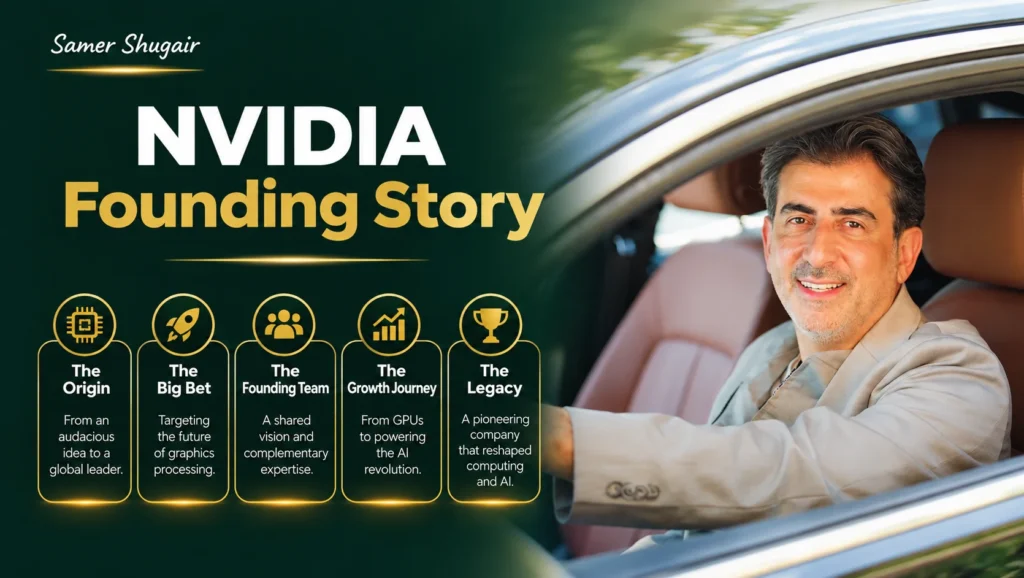
In my content on Vision 2030 and long term technology opportunities, followed by a wide audience, I keep returning to the Nvidia story because it illustrates a rare principle: staying in the game long enough for a technology bet to mature. The company was founded in April 1993 by Jensen Huang, Chris Malachowsky, and Curtis Priem, after meetings at a Denny’s restaurant in San Jose. Huang has been CEO since day one, and the initial goal was to develop 3D graphics chips for PCs and gaming.
The beginning was not smooth. The first product, the NV1, in the mid 1990s used a rendering approach that was incompatible with the standard Microsoft set (DirectX). It failed commercially and nearly bankrupted the company. Accounts suggest the company came close to running out of cash more than once in its early years. The turnaround came with the RIVA 128 chip in 1997, which adopted the prevailing standards, followed by the IPO in 1999 and the launch of the GeForce 256, marketed as the first graphics processing unit (GPU).
In this article, on the Samer Choucair platform, we tell the Nvidia founding story and its key stages, explain why the CUDA platform bet was the real turning point, and then review the investment lessons Samer draws from it and how to apply them when assessing technology companies in the context of Vision 2030.
Key Takeaways
- Survival before speed: The first lesson of the Nvidia founding story: the company survived the failure of its first product before finding its way.
- A bet that took over a decade: The CUDA platform launched in 2006, and its major impact came years later with the AI boom.
- A platform beats a product: In the Nvidia founding story, software, hardware, and a developer community together built a barrier that is hard to copy.
- An operational margin of safety: The ability to fund infrastructure through years of weak demand was the condition for success in the Nvidia founding story.
- Price is part of the decision: Even a great company can be a poor investment if the price leaves no room for delay.
Table of Contents
- What Is the Nvidia Founding Story?
- What Were Nvidia’s Key Milestones From 1993 to the AI Boom?
- Why Was the CUDA Platform the Decisive Bet?
- How Does Samer Choucair Read the Story as an Investor?
- What Are the Investment Lessons From the Nvidia Founding Story?
- What Does the Nvidia Founding Story Teach Entrepreneurs?
- How Do You Apply These Lessons to Technology Companies?
- Frequently Asked Questions
- Conclusion
What Is the Nvidia Founding Story?
Short Answer
The Nvidia founding story begins in April 1993, when Jensen Huang, Chris Malachowsky, and Curtis Priem founded the company to build 3D graphics chips for gaming. After its first product failed and the RIVA 128 and GeForce 256 succeeded, the company bet in 2006 on the CUDA platform, which turned graphics processing units into general purpose computing tools and later made Nvidia a leading platform for artificial intelligence.
The importance of the Nvidia founding story lies not only in its eventual success, but in the road it took to get there. The company that is now one of the best known names in artificial intelligence started as a small firm making gaming chips, nearly disappeared a few years after its founding, and then made a strategic decision that few understood at the time.
That is why Samer Choucair returns to it when discussing long term technology opportunities: it is a practical example of how big value in technology investing rarely comes from perfect timing, but from the ability to survive until the bet matures.
What Were Nvidia’s Key Milestones From 1993 to the AI Boom?
The Nvidia founding story and its path can be summed up in a series of key milestones:
| Year | Milestone | Significance |
|---|---|---|
| 1993 | Founded by Huang, Malachowsky, and Priem | A bet on the 3D gaming graphics market |
| Mid 1990s | NV1 launches and fails commercially | Incompatibility with DirectX nearly bankrupted the company |
| 1997 | RIVA 128 launches | Adoption of prevailing standards and the start of recovery |
| 1999 | IPO and launch of GeForce 256 | Marketed as the first GPU |
| 2006 | CUDA platform launches | Parallel processing opened up for general purpose use |
| 2008 | Sharp decline in the share price | Margin pressure while spending on the platform continued |
| 2010s | The deep learning boom | The long term bet becomes a competitive barrier |
One moment often cited along this path came in 2012, when researchers at the University of Toronto used Nvidia graphics processing units to train the AlexNet model, which achieved a leap in the ImageNet image recognition competition. It is widely seen as one of the clearest signals of the start of the deep learning era, and an example of how Nvidia’s early bet met a new demand that was not obvious when the platform launched. It is one of the most important chapters in the Nvidia founding story, because it shows the moment the bet met demand.
These milestones show that the Nvidia founding story is not a straight upward line, but a series of stumbles, adjustments, and long bets, which is what makes it a practical lesson for entrepreneurs and investors alike. Few corporate histories show the cost of patience as clearly as the Nvidia founding story.
Why Was the CUDA Platform the Decisive Bet?
The point I focus on when analysing stories like this is the bet that took more than a decade to show its impact. In 2006 Nvidia launched CUDA, a software architecture that allows the parallel processing power of graphics units to be used for general purposes beyond graphics, such as scientific computing and later deep learning. The cost was high: development spending rose and pressured margins for years, while clear demand was limited. The stock saw sharp declines in later periods, including a large drop in 2008. Continuing to fund the platform despite the lack of immediate returns is what later built the competitive barrier when demand for training AI models exploded.
Short Answer
Because the CUDA platform turned graphics processing units from a gaming product into a general purpose computing platform, and built a community of developers, tools, and libraries around it. When demand for training AI models arrived, Nvidia already had an integrated system that competitors could not copy quickly.
The difference between a product and a platform is the heart of this part of the Nvidia founding story. A product is sold once, and a competitor can make something similar. A platform attracts developers who write their software on it, and the more of them there are, the higher the cost of switching to an alternative. That is why a competitive advantage built on platforms is stronger and longer lasting than one built on a single product.
The platform the Nvidia founding story produced can be summed up in three connected components:
|
Hardware Graphics processing units capable of running thousands of operations in parallel. |
Software The CUDA architecture, libraries, and tools that make this power usable beyond graphics. |
|
Developers A large community of researchers and programmers who built their work on the platform for years. |
How Does Samer Choucair Read the Story as an Investor?
Morgan Housel, in The Psychology of Money, describes how big results usually come from staying with a reasonable plan for a long time, not from repeatedly perfect decisions. The Nvidia story applies this in practice: the company survived early product mistakes, then allocated resources to a platform most gaming customers did not ask for at first. Benjamin Graham focused on the margin of safety in valuation; here a different, operational margin of safety appears: the ability to endure years of infrastructure investment before the market is ready. Michael Porter, in his work on competitive advantage, explains the importance of building a system that is hard to copy; CUDA and its developer ecosystem later became that system.
The table below summarises how these three references meet the Nvidia founding story:
| Reference | Idea | How It Shows in the Story |
|---|---|---|
| Morgan Housel | Staying with a reasonable plan for a long time | Surviving the NV1 failure and sticking with the CUDA bet |
| Benjamin Graham | Margin of safety | An operational margin of safety to endure years of investment before the market matured |
| Michael Porter | Building a system that is hard to copy | CUDA plus the developer community as a competitive barrier |
This framework combines three complementary angles: patience from Housel, caution from Graham, and strategic building from Porter. For a deeper look at how to build a competitive advantage at the business level, the article on competitive advantage explains the same principles in practice.
What Are the Investment Lessons From the Nvidia Founding Story?
Within Vision 2030, where investment in artificial intelligence and digital infrastructure is expanding, I see the story as a reminder of three practical points:
| 01 |
Survival matters more than speed in the early stages Many companies in emerging sectors disappear before the technology or the demand matures. |
| 02 |
Betting on a platform differs from selling a single product Betting on a platform (software + hardware + developers) differs from selling a single product. The return may be delayed, but the barrier becomes stronger. |
| 03 |
The price must leave room for delay The price you pay today should leave room for the timeline to slip or for growth to come slower than the market expects. Those who bought the stock during periods of high valuation after 2023 were betting on continued exceptional growth; those who focused on the company’s ability to generate cash flows from the platform focused on the fundamentals. |
I do not see the story as a guarantee that the results will repeat. Competition in chips and software is increasing, and demand for artificial intelligence may fluctuate with economic cycles and energy costs. But the principle holds: companies that build infrastructure that is hard to replace quickly, and can fund it through periods of weak demand, have wider options when the market changes.
The first lesson connects directly to the idea of resilience in a crisis: Nvidia’s ability to get past the NV1 failure is what kept it in the market until its biggest bet arrived. The article on entrepreneurial resilience explains how founders build that capacity in their own businesses.
Editorial Insight
In the great technology stories, the winner is not always the one who sees the future first, but the one who can survive until the future arrives.
What Does the Nvidia Founding Story Teach Entrepreneurs?
Short Answer
The Nvidia founding story teaches that early failure does not end a business if the founder learns from it quickly, that compatibility with market standards is a condition for growth, and that major strategic decisions may need years before they prove right.
This story is not only for investors; it offers direct lessons for entrepreneurs. The first product may not succeed, and what matters is how quickly you understand why and change course, as Nvidia did when it moved from the NV1 to the standards compatible RIVA 128. This early pivot is one of the most practical chapters of the Nvidia founding story.
The Nvidia founding story also shows the importance of clear vision in leadership. Continuing to fund a platform most customers did not ask for at first requires long term conviction, and the ability to explain that bet to the team and shareholders through years without visible results. That combination of boldness and discipline is at the core of an entrepreneurial mindset.
Finally, the Nvidia founding story is a reminder that the hardest advantage for competitors to match is not the product, which can be copied, but the system built around it: customers, developers, partners, and accumulated expertise. That advantage cannot be bought with money alone; it is built with time.
How Do You Apply These Lessons to Technology Companies?
In my discussions on capital allocation within Vision 2030, I return to examples like this because the new generation of investors faces similar technology opportunities. The question is not only “will the technology succeed?”, but “can the company bear the time and cost until the technology becomes economically viable, and does the current price leave a margin for that wait?”
Short Answer
The lessons of the Nvidia founding story apply through three questions: does the company have the financial capacity to survive until the technology matures? Is it building a platform that is hard to replace, or a product that is easy to copy? And does the current price leave a margin for slower growth?
Building on the questions Samer raises and the Nvidia founding story, investors can use the following checklist when assessing any technology company, early stage or listed:
- ☐Does the company have cash or funding sources to cover years of investment before demand matures?
- ☐Is it building a platform (hardware, software, and a user community) or selling a single product that is easy to copy?
- ☐Is the number of developers or customers who depend on its technology growing over time?
- ☐Is its technology compatible with prevailing market standards, or is it betting on a different one?
- ☐Does the current price assume continued exceptional growth, or does it leave room for delay?
Turning these questions into a decision needs a clear method that reduces the effect of the enthusiasm surrounding popular tech sectors, and the article on business decision making frameworks offers tools that help.
In the Saudi context, as investment in artificial intelligence, data centres, and digital infrastructure expands under Vision 2030, the Nvidia founding story becomes a useful reference for assessing local opportunities, and Saudi founders can borrow its playbook of patience and platform building. Companies that build real capabilities and have the capacity for patience are best placed to create long term value, while investors need to be careful of valuations that assume everything will go according to the best case scenario.
Disclaimer
This article is for general awareness and is not investment advice or a recommendation to buy any stock. Every investor has different circumstances, goals, and risk tolerance. Consult a licensed professional and verify regulations with the Capital Market Authority before making any decision.
Sources
Company founding records from 1993 (Huang, Malachowsky, Priem); the early product path (NV1, then RIVA 128 and GeForce); the 2006 launch of CUDA and its later impact on the data centre business; the AlexNet model and the 2012 ImageNet competition; principles from Housel’s The Psychology of Money, Graham’s The Intelligent Investor, and Porter’s work on competitive advantage.
Frequently Asked Questions
When was Nvidia founded and by whom?
In April 1993, by Jensen Huang, Chris Malachowsky, and Curtis Priem, with Huang serving as CEO from the start.
Why did Nvidia’s first product, the NV1, fail?
Because it used a rendering approach incompatible with the DirectX standard Microsoft set, so it failed commercially and nearly bankrupted the company.
What is the CUDA platform?
A software architecture Nvidia launched in 2006 that allows the parallel processing of graphics units to be used for general purposes such as scientific computing and deep learning.
What is the most important lesson of the Nvidia founding story?
That survival and the ability to fund a long term bet through periods of weak demand can matter more than speed or perfect timing.
Does the Nvidia story guarantee the same results for other companies?
No. Competition is increasing and demand may fluctuate, but the principle holds: companies that build hard to replace infrastructure and can fund it have wider options.
How do I apply the lessons when assessing technology companies?
Ask whether the company can survive until the technology matures, whether it is building a platform or a product, and whether the current price leaves room for slower growth.
Conclusion
The Nvidia founding story is not a story of quick success, but one of survival, a long bet, and patience with a return that took more than a decade. Investors can learn from it that the most important question is not only whether the technology will succeed, but whether the company can bear the time and cost until it does, and whether the price leaves a margin for that wait.
What lesson do you draw from the Nvidia story when assessing technology companies today? Share your view, and follow Samer Choucair’s analysis of building long term competitive positions in growth sectors.
Samer Choucair
Entrepreneur and investor writing about entrepreneurship, investment, strategic thinking, and business growth in the Arab world.