
Schools of Investing: How an Investment Mindset Takes Shape
Vision 2030
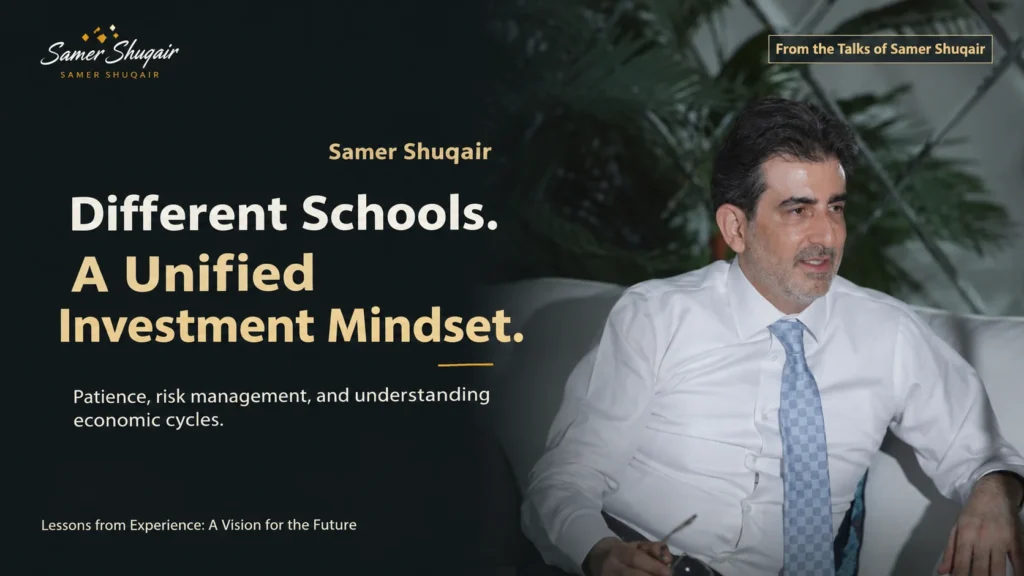
“Different schools. An investment mindset taking shape.” From Benjamin Graham and Philip Fisher to Markowitz, Bogle, and Dalio, we explore the major schools of investing and how their lessons can come together in three pillars Samer Choucair names: patience, risk management, and understanding economic cycles.
Samer Choucair, investment entrepreneur
No investor is born with a ready made philosophy. An investment mindset takes shape over time, through books, experience, and mistakes, and through exposure to different schools that each see the market from their own angle. In his series “Lessons of Experience”, Samer Choucair sums up this journey in a short phrase: “Different schools. An investment mindset taking shape.”
He adds three words that capture the conclusion: patience, risk management, and understanding economic cycles. These three pillars are not the invention of any single school. They are what usually remains when an investor studies the different schools of investing and takes from each what suits their own circumstances and goals.
In this article, on the Samer Choucair platform, we review the major schools of investing that shaped modern financial thinking, explain the core idea of each school along with its strengths and limits, and then show how an investor can build a personal investment philosophy around these three pillars.
Key Takeaways
- No school is complete: Each of the schools of investing sees part of the truth, and each has its limits.
- Patience is a competitive edge: Most successful schools depend on a long horizon that gives value time to appear.
- Risk before return: The first question is not how much I will make, but how much I could lose and whether I can bear it.
- The economy moves in cycles: Understanding the cycle helps adjust behaviour and size, not predict the top or the bottom.
- A personal philosophy is built: A mature investment mindset is a deliberate blend of lessons from several schools, not a copy of one.
Table of Contents
- What Are the Schools of Investing?
- The Value School: Benjamin Graham
- The Growth School: Philip Fisher
- Modern Portfolio Theory: Harry Markowitz
- Passive Investing: John Bogle
- The Macro and Cycles School: Ray Dalio and Howard Marks
- The Behavioral School: Daniel Kahneman
- Three Pillars That Unite the Lessons
- How to Build Your Investment Philosophy
- Frequently Asked Questions
- Conclusion
What Are the Schools of Investing?
Samer Choucair (translated from Arabic)
Different schools. An investment mindset taking shape.
Short Answer
The schools of investing are the different intellectual approaches to choosing assets and managing portfolios, such as the value school, the growth school, modern portfolio theory, passive investing, the macro school, and the behavioral school. Each defines opportunity and risk differently, and each uses different tools to make decisions.
Knowing the schools of investing does not mean picking one and defending it at all costs. An investor who understands more than one school sees the market through several lenses and knows when a tool works and when it fails. That is how an investment mindset takes shape gradually, rather than being copied ready made.
What follows is an editorial reading of six major schools of investing, linking each to the three pillars Samer Choucair names: patience, risk management, and understanding economic cycles.
The Value School: Benjamin Graham
Benjamin Graham is considered the founding father of value investing, through his books Security Analysis (1934), written with David Dodd, and The Intelligent Investor (1949). His core idea is that every company has an intrinsic value that can be estimated, and that the market sometimes drifts far from it, up or down.
One of his best known concepts is the “margin of safety”, meaning buying at a price clearly below estimated value, so the investor keeps a buffer against errors in judgement. He also introduced “Mr. Market”, a moody partner who offers different prices every day; the investor should take advantage of his moods rather than follow them. Among all the schools of investing, this one most clearly combines patience with risk management.
Practical Lesson
Price is what you pay; value is what you get. The margin of safety is the first tool of risk management.
The Growth School: Philip Fisher
In Common Stocks and Uncommon Profits (1958), Philip Fisher focused on companies able to grow for many years thanks to the quality of their management, their products, and their capacity to innovate. He called for deep research into a company from many sources, including customers, suppliers, and competitors, an approach he called “scuttlebutt”.
Fisher’s work also influenced Warren Buffett, showing how two schools of investing can complement rather than contradict each other.
This school differs from the value school in its willingness to pay a higher price for exceptional quality and sustainable growth. Of all the schools of investing, growth investing depends heavily on patience, because the effect of growth takes years to show up in the price.
| ✕ |
Limits of the SchoolA focus on growth can turn into ignoring price entirely, especially in periods of euphoria, so that the investor pays a price no amount of growth can justify. |
Modern Portfolio Theory: Harry Markowitz
In 1952, Harry Markowitz published his paper “Portfolio Selection”, which laid the foundation for modern portfolio theory, and he later received the Nobel Prize in Economics in 1990. Its core idea is that investors should not look at each asset alone, but at the whole portfolio and how its assets move together.
From this theory came the well known principle: diversifying across assets that do not move the same way reduces risk without necessarily sacrificing return. That is why this school is the scientific foundation of risk management in most modern schools of investing.
Passive Investing: John Bogle
John Bogle founded Vanguard in 1975 and, a year later, launched the first index fund aimed at individual investors. His idea was that most investors will not beat the market after fees and costs, and that owning the whole market at low cost over a long period is a rational choice for many.
This school represents the purest form of patience among the schools of investing: no attempt to time the market, no chasing opportunities, just a long term commitment to a simple, low cost plan.
The Macro and Cycles School: Ray Dalio and Howard Marks
The macro school looks at the economy as a whole: interest rates, inflation, debt, and liquidity. Ray Dalio, founder of Bridgewater, is one of its best known representatives, and in his books he explains how economies move through short and long debt cycles, and how different assets behave in each economic environment.
Howard Marks, in Mastering the Market Cycle (2018), offers the image of a pendulum swinging between optimism and pessimism. His message is that understanding economic cycles does not mean predicting exact timing, but knowing roughly where we stand and adjusting size and behaviour accordingly. Of all the schools of investing, this one is closest to the third pillar: understanding economic cycles.
In Gulf markets, where liquidity is shaped by oil prices and government spending, understanding economic cycles becomes a practical tool rather than a theoretical luxury. Of all the lessons the schools of investing offer, this may be the most relevant to Saudi investors.
The Behavioral School: Daniel Kahneman
Daniel Kahneman received the Nobel Prize in Economics in 2002 for his research with Amos Tversky on how people make decisions under uncertainty. That research showed that investors are not rational machines; they are influenced by fear of loss, overconfidence, and a bias toward the familiar.
The behavioral school adds an important question to the other schools of investing: even if the strategy is right, will the investor stick to it when pressure builds? That is why protecting decisions from emotion and exhaustion is part of any successful philosophy, as the article on how to avoid decision fatigue as an entrepreneur explains.
| School | Core Idea | Closest Pillar |
|---|---|---|
| Value (Graham) | Buy below intrinsic value with a margin of safety | Patience and risk management |
| Growth (Fisher) | Exceptional companies that grow for years | Patience |
| Modern portfolio (Markowitz) | Diversify based on how assets relate to each other | Risk management |
| Passive (Bogle) | Own the market at low cost for the long term | Patience |
| Macro and cycles (Dalio and Marks) | Understand the economic environment and where we are in the cycle | Understanding economic cycles |
| Behavioral (Kahneman) | Psychological biases shape decisions | Behavioral risk management |
Seen side by side, the schools of investing look less like rivals and more like complementary lenses on the same market.
Three Pillars That Unite the Lessons
Samer Choucair sums up what remains from the different schools of investing in three pillars (translated from Arabic): “Patience, risk management, and understanding economic cycles.” Below is an editorial reading of each pillar:
Patience
Patience appears in most of the schools of investing: in Graham waiting for price to approach value, in Fisher’s long horizon, and in Bogle’s commitment to the market over decades. Patience here is not passive waiting; it is the ability to bear volatility without abandoning a considered plan. That depends on psychological steadiness, the subject of the article on entrepreneurial resilience.
Risk Management
Risk management is the common thread between Graham’s margin of safety, Markowitz’s diversification, and Kahneman’s awareness of bias. Its central question is: what is the worst that could happen, and can I bear it without being forced into a wrong decision?
Understanding Economic Cycles
The economy does not move in a straight line, and markets swing between optimism and pessimism. Understanding economic cycles helps the investor be cautious when others are euphoric, and better prepared for opportunity when fear dominates.
Editorial Insight
One school gives you a tool. Many schools give you the judgement to know when to use each tool.
How to Build Your Investment Philosophy
Building a personal investment philosophy does not mean inventing a new school. It means choosing deliberately from the existing schools of investing what fits your goals and circumstances. You can start with these steps:
| 01 |
Read the original sources Start with one book from each school; reading the source gives a deeper understanding than summaries. |
| 02 |
Define your time horizon Are you investing for a few years or for decades? Your horizon determines which schools suit you best. |
| 03 |
Know your risk tolerance How would you behave if your portfolio fell sharply? An honest answer sets the right level of risk. |
| 04 |
Write your rules Write down when you buy, when you sell, and how you allocate, before you need those decisions under pressure. |
| 05 |
Review and learn Record your decisions and the reasons behind them, then review them later to see what worked and what needs to change. Over time, your notes will show which of the schools of investing truly fits you. |
Each of these steps is a decision that deserves a clear method, and the article on business decision making frameworks offers tools that help organise your thinking before major decisions.
- ☐Do I know which school my current approach leans toward?
- ☐Do I have written rules for buying, selling, and allocation?
- ☐Is my portfolio diversified enough to protect me from a single shock?
- ☐Do I know roughly where the market stands in the economic cycle?
- ☐Does my time horizon match the assets I own?
With Saudi Vision 2030, the development of the Saudi capital market, and the growing range of investment tools, the need for a mature investment mindset is greater than ever. More choice demands a clearer philosophy, and understanding the different schools of investing is the path to building one.
Disclaimer
This article is for general awareness of investment thinking and is not investment advice. Every investor has different circumstances, goals, and risk tolerance. Consult a licensed professional and verify regulations with the Capital Market Authority before making any decision.
Sources
Benjamin Graham and David Dodd, Security Analysis (1934); Benjamin Graham, The Intelligent Investor (1949); Philip Fisher, Common Stocks and Uncommon Profits (1958); Harry Markowitz, Portfolio Selection, Journal of Finance (1952); John Bogle and the Vanguard Group; Ray Dalio, Principles; Howard Marks, Mastering the Market Cycle (2018); Daniel Kahneman, Thinking, Fast and Slow (2011).
Frequently Asked Questions
What are the best known schools of investing?
They include the value school of Benjamin Graham, the growth school of Philip Fisher, the modern portfolio theory of Harry Markowitz, the passive investing of John Bogle, the macro school of Ray Dalio, and the behavioral school associated with Daniel Kahneman.
Which investing school is the best?
No school is best for everyone. Each has strengths and limits, and the right fit depends on the investor’s goals, time horizon, and risk tolerance.
How does an investment mindset take shape?
Through reading, experience, and mistakes, and by understanding more than one school, then choosing what fits your personal circumstances and turning it into written rules.
What are the three pillars Samer Choucair names?
Patience, risk management, and understanding economic cycles.
Can you combine more than one of the schools of investing?
Yes, and many investors do, for example valuing companies using the value school while diversifying according to portfolio theory and staying aware of behavioral biases.
Conclusion
The schools of investing are not competing teams that demand loyalty to one side; they are different lenses on the same market. From Graham and Fisher to Markowitz, Bogle, Dalio, and Kahneman, the lessons meet at three pillars: patience, risk management, and understanding economic cycles.
Which school do you feel closest to today, and what have you learned from it? Share your experience, and follow the “Lessons of Experience” series with Samer Choucair for more of the lessons that shaped his view of investing.
Samer Choucair
Entrepreneur and investor writing about entrepreneurship, investment, strategic thinking, and business growth in the Arab world.