
How to Transition From Employee to Entrepreneur
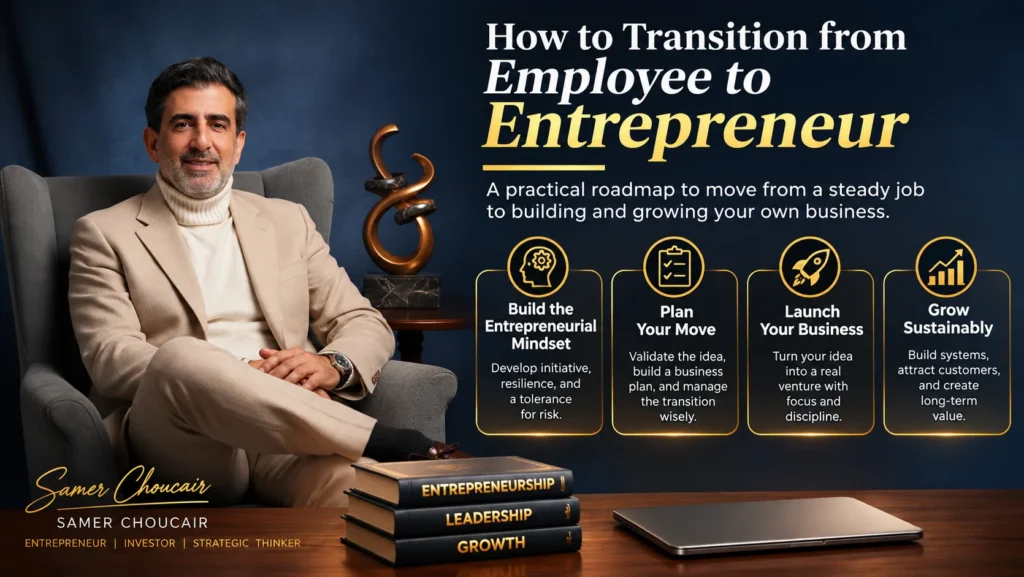
Entrepreneurship
A practical, stage-by-stage guide to how to transition from employee to entrepreneur: assess your readiness, test your idea while still employed, build a financial runway, and choose the right moment to make the move.
Samer Choucair, investment entrepreneur
A steady salary, benefits, and a clear career path. And yet many employees feel they have an idea worth building, or that they want to make decisions rather than carry them out. Between that wish and the decision, however, lies a long distance, and many people try to cross it in a single unplanned leap, losing both the job and the business.
The right question is not “should I resign?” It is how to transition from employee to entrepreneur in a deliberate way that lowers risk and improves the odds of success. A successful transition is rarely a leap; it is a path with clear stages.
This guide, part of the Entrepreneurship series on the Samer Choucair platform, explains how to transition from employee to entrepreneur step by step: how to assess your readiness, test your idea before resigning, build your financial runway, recognize the right moment for leaving corporate job to start a business, and avoid the most common mistakes.
Key Takeaways
- A path, not a leap: The best answer to how to transition from employee to entrepreneur is to move in stages, not to resign suddenly.
- Test before you quit: Your current job is the best funder for testing your idea and proving that customers will pay.
- Runway first: Do not give up your salary before you know how many months you can live without it.
- The mindset shifts: Going from employee to entrepreneur means moving from completing tasks to owning results entirely.
- The right moment has signals: Real demand, early revenue, and enough savings are clearer signals than enthusiasm alone.
In this article
- What Changes When You Go From Employee to Entrepreneur
- Stage 1: Assess Your Readiness Honestly
- Stage 2: Test Your Idea While Employed
- Stage 3: Build Your Financial Runway
- Stage 4: Close the Skills Gap
- Stage 5: When Should You Leave Your Job?
- Common Transition Mistakes
- Making the Transition in the Saudi Market
- Frequently Asked Questions
- Conclusion
What Changes When You Go From Employee to Entrepreneur
Short Answer
How to transition from employee to entrepreneur comes down to five stages: assess your personal and financial readiness, test your idea while still employed, build a financial runway that covers enough months, close your skills gap, and leave your job only when clear signals appear, such as real demand and early revenue from the business.
Before the steps, it is worth understanding that the move is not just a change of workplace. It is a change in how you think and what you are responsible for. This is the core of understanding how to transition from employee to entrepreneur:
| Area | As an employee | As an entrepreneur |
|---|---|---|
| Income | Fixed salary on schedule | Variable income tied to results |
| Decisions | You carry out others’ decisions | You decide and own the outcome |
| Responsibility | Your own tasks | Everything: sales, operations, the team |
| Time | Defined working hours | Flexible, but usually longer |
| Risk | Relatively low | Higher, and needs conscious management |
This echoes the distinction in entrepreneur vs business owner: owning an activity does not make you an entrepreneur. You need to think about growth, innovation, and building a system that works.
Stage 1: Assess Your Readiness Honestly
The first step in how to transition from employee to entrepreneur is asking yourself honestly whether entrepreneurship suits you at all. Not every successful employee becomes a successful entrepreneur, and the reverse is also true. The self-assessment in is entrepreneurship right for you helps you answer that question.
When working out how to transition from employee to entrepreneur, focus your assessment on three dimensions:
- Psychological readiness: can you handle uncertainty, delayed results, and variable income?
- Family readiness: does your family support the decision, and do your commitments allow a period of lower income?
- Your real motivation: are you running away from a job you dislike, or moving toward an idea you believe in? Escape alone is a weak motivator.
Stage 2: Test Your Idea While Employed
One of the most important principles of how to transition from employee to entrepreneur is using your job to fund the testing stage. Your salary gives you time to test the idea without the pressure of needing immediate income. The guide on how to validate a business idea covers practical methods.
| 01 |
Define the problem and the customer Who has the problem you solve, and how do they solve it today? |
| 02 |
Talk to potential customers Gather real feedback before building anything, and focus on what people do, not what they say. |
| 03 |
Build a simple version A manual service or an early product in your evenings and weekends. |
| 04 |
Get your first paying customer Payment is the strongest proof that the idea is worth pursuing. |
| 05 |
Write a clear plan Turn what you learned into a plan; how to write a business plan helps you structure it. |
As you test, watch for the early signs of product market fit: customers who come back, refer others, and would be disappointed if your offer disappeared. These signs matter far more than compliments when deciding how to transition from employee to entrepreneur.
Important
Review your employment contract and your employer’s policies before starting any side activity, especially non-compete and conflict-of-interest clauses, and confirm the regulatory requirements for your activity with the relevant official authorities.
Stage 3: Build Your Financial Runway
You cannot talk about how to transition from employee to entrepreneur without talking about money. What pushes new businesses into bad decisions more than anything else is the pressure to earn fast. So:
| 1 | Calculate your essential monthly expenses precisely. |
| 2 | Work out how many months you can live without a salary. The longer the runway, the calmer your decisions. |
| 3 | Keep living savings separate from business capital. |
| 4 | Reduce fixed commitments as much as possible before the move. |
If capital is limited, the road is not closed. Some models start with very few resources, and how to start a business with no money explains how to begin with skills and services before major investment. The checklist in what do you need to start a business also helps you list the essentials before launching. Financial preparation is an inseparable part of how to transition from employee to entrepreneur safely.
Stage 4: Close the Skills Gap
Employees are often specialists in one area, while entrepreneurs need many skills. A core part of how to transition from employee to entrepreneur is identifying the skills you lack and starting to build them before you resign.
|
Selling The most important early skill. If you cannot sell your idea, no one else will. |
Financial management Reading cash flow, costs, and pricing. |
|
Decision-making Deciding with incomplete information and owning the result. |
Building relationships Customers, suppliers, and advisers form a network you cannot do without. |
The article on essential skills every entrepreneur needs covers these in detail. The advantage of building them while employed is that you learn without putting your business and savings on the line.
If your skills gap is large, a partner who complements you may help as you work out how to transition from employee to entrepreneur. Choose carefully, though; how to choose the right business partner explains what to look for and how to structure the partnership.
Stage 5: When Should You Leave Your Job?
This is the hardest moment in how to transition from employee to entrepreneur. The article should you quit your job to start a business discusses the decision itself in depth, but these are the main signals that leaving corporate job to start a business has become a logical step:
- ☐You have paying customers, not just interest or praise.
- ☐The business generates early revenue, even if small.
- ☐You have savings that cover living costs for a sufficient period.
- ☐Your spare time is no longer enough to meet demand.
- ☐You have a clear plan for the first months after the move.
In how to transition from employee to entrepreneur, timing matters more than speed. If most of these signals are missing, it is usually better to keep building alongside your job. Middle options, such as reduced hours or a more flexible role, may also be worth exploring where available.
Editorial Insight
Resigning is not the start of the business. It is the sign that the business has already started and now needs all of your time.
Common Transition Mistakes
Understanding how to transition from employee to entrepreneur also means knowing what to avoid. These mistakes come up again and again:
| ✕ |
Resigning before testing the ideaBuilding an entire business on an assumption that was never tested with real customers. |
| ✕ |
Underestimating time and moneyExpecting the business to earn enough within a few months, then burning through savings too early. |
| ✕ |
Bringing the employee mindsetWaiting for instructions, or focusing on technical work while neglecting sales and marketing. |
| ✕ |
Burning bridgesLeaving your employer badly, when former colleagues and managers could become your first customers or supporters. |
Making the Transition in the Saudi Market
Under Vision 2030, the Saudi market is giving growing support to entrepreneurship and small and medium enterprises, which makes how to transition from employee to entrepreneur a live question for many employees. To make the most of this environment:
- Learn about the entrepreneur support and financing programs available, and verify their current conditions with the official authorities.
- Use your professional experience and network; they are among your strongest assets at the start.
- Start in a sector you know well from your job, since understanding market needs from the inside is a real advantage.
- Confirm licensing and commercial registration requirements for your activity before launching.
For the full picture of the road once you know how to transition from employee to entrepreneur, how to become an entrepreneur offers a comprehensive guide to the stages of building a business.
Frequently Asked Questions
What is the best way to learn how to transition from employee to entrepreneur?
Follow five stages: assess your readiness, test the idea while employed, build a financial runway, close your skills gap, and leave your job when clear signals appear, such as paying customers and early revenue.
Should I quit my job before starting my business?
In most cases, no. It is usually better to test the idea alongside your job, then resign once the business shows real demand and early revenue.
How much savings do I need before leaving my job?
There is no single number. Calculate your essential expenses, work out how many months you can live without a salary, and remember that a longer runway leads to calmer decisions.
What is the hardest part of going from employee to entrepreneur?
Usually the mindset shift: from completing tasks and waiting for instructions to owning decisions and results entirely, while living with variable income and uncertainty.
Is leaving corporate job to start a business always the right decision?
Not always. It depends on your personal and financial readiness and on real demand for your idea. Some people are better suited to staying employed while running a side business.
Conclusion
How to transition from employee to entrepreneur is not a decision you make in a single day. It is a staged journey that begins while you are still in your job. The earlier you test your idea, build your runway, and develop your skills, the more the move becomes a calculated step rather than a gamble.
Start this month with one step: talk to five potential customers about the problem you want to solve. Those conversations will tell you more about your idea than any written plan.
Samer Choucair
Entrepreneur and investor writing about entrepreneurship, investment, strategic thinking, and business growth in the Arab world.