
Can You Be a Great Manager Without Being a Leader?
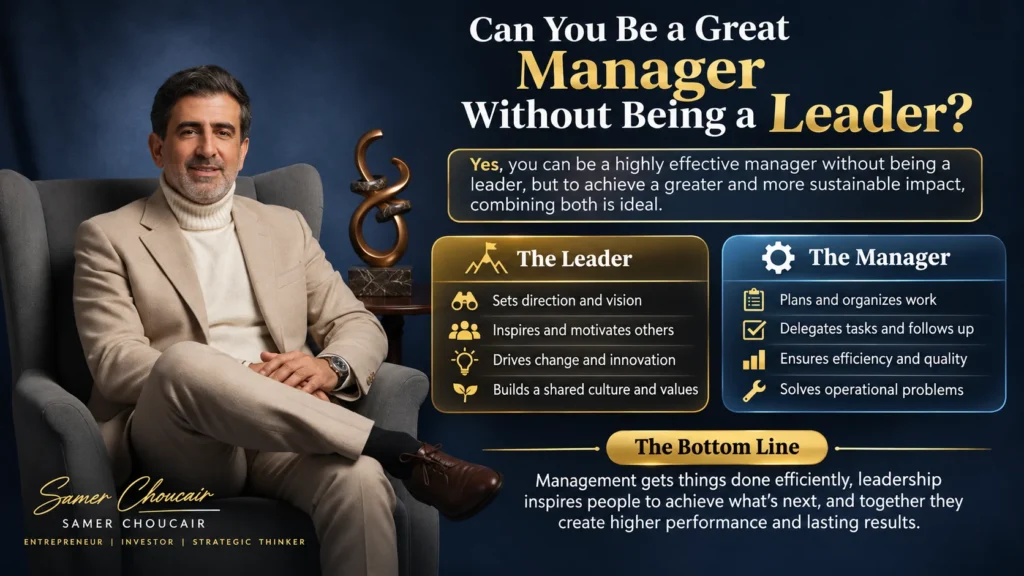
Leadership & Management
A clear answer to whether you can be a great manager without being a leader: how far disciplined management alone can take a team, when the absence of leadership becomes a ceiling, and how to add the minimum leadership you need without changing your personality.
Samer Choucair, investment entrepreneur
A manager delivers every report on time, keeps the budget under control, runs clear processes, and never misses a follow-up. Yet when they are away for a week, the team stalls. When priorities change, everyone resists. And the best people leave after a year or two. That raises a real question: can you be a great manager without being a leader?
The question is fair, because many managers are not natural leaders. They do not enjoy inspirational speeches or the spotlight, but they excel at organizing and executing. The short answer is yes, up to a point, and no beyond it. Excellent management builds a disciplined team, but the absence of leadership puts a ceiling on what that team can achieve.
This guide, part of the Entrepreneurial Mindset series on the Samer Choucair platform, answers whether you can be a great manager without being a leader, explains when management discipline is enough and when it is not, describes the signs of a manager without leadership skills, and outlines the minimum leadership behaviors every manager needs and how to build them without changing who you are.
Key Takeaways
- Short answer: Can you be a great manager without being a leader? Yes in stable environments with clear tasks, but your impact stays limited when the team needs direction, motivation, or someone to lead change.
- Management organizes, leadership mobilizes: Management makes sure work gets done efficiently; leadership makes people want to do it and take ownership of it.
- Leadership is behavior, not personality: You do not need charisma. You need to practice a small set of leadership behaviors consistently.
- The ceiling appears with change: As conditions shift or the team grows, the gap between a good manager and a manager without leadership skills becomes much more visible.
- A minimum is enough to start: Clear direction, trust, real delegation, and developing people can turn a disciplined manager into an influential one.
In this article
- Can You Be a Great Manager without being a leader? The Short Answer
- Great Manager vs Manager Who Also Leads
- When Management Alone Is Enough
- When the Absence of Leadership Becomes a Ceiling
- Signs of a Manager without leadership skills
- The Minimum Leadership Every Manager Needs
- How to Add Leadership Without Changing Your Personality
- Managers and Leaders in the Saudi Workplace
- Frequently Asked Questions
- Conclusion
Can You Be a Great Manager without being a leader? The Short Answer
Short Answer
Yes, you can be a great manager without being a leader in the traditional sense: excellent at planning, organizing, and follow-up, and successful in stable environments with clear tasks. But management alone reaches its limits when the team needs new direction, motivation through difficult periods, development of its capabilities, or someone to lead change. At that point, the absence of leadership becomes a ceiling on your team’s performance and your own.
To answer precisely, we first need to separate the two roles. The guide on leadership vs management explains that distinction in detail. Here we focus on one practical question: how far can you succeed as a manager without being a leader?
|
Management answers “how” How we execute, when, with which resources, and who is responsible. |
Leadership answers “why” Why this goal matters, and why it deserves the team’s effort. |
|
Discipline creates stability A disciplined manager prevents chaos and protects quality. |
Leadership creates commitment A leader helps people take ownership, not just follow instructions. |
Great Manager vs Manager Who Also Leads
A great manager is not necessarily a leader, and an inspiring leader is not necessarily a good manager. To understand what it means to be a manager without being a leader, this table shows what each profile does well:
| Dimension | Great manager without leadership | Manager who also leads |
|---|---|---|
| Goals | Executes defined goals precisely | Explains why goals matter and connects them to the bigger picture |
| Team | Assigns and tracks tasks | Develops people and delegates decisions |
| Change | Implements it when asked | Initiates it and persuades the team it is needed |
| Crises | Protects operations and resources | Protects operations and trust together |
| Source of influence | Authority and procedures | Authority, trust, and example |
| Team in their absence | Waits for instructions | Keeps working and making decisions |
A manager who masters the first column has a strong foundation; these are the management skills no team can do without. But the second column is what turns that foundation into performance that exceeds expectations.
When Management Alone Is Enough
In some situations, the answer to whether you can be a great manager without being a leader is clearly yes:
- When tasks are routine and clear, and procedures are stable and well known.
- When the team consists of experienced people with strong self-motivation.
- When a higher level of the organization sets direction and vision, and your role is execution.
- When the timeframe is short, such as a project with a fixed scope and deadline.
- When the role is purely technical or operational, such as running operations, quality, or compliance.
In these environments, discipline, organization, and precise follow-up may be what the team needs most, and an organized manager often outperforms an inspiring leader who lacks structure. In this context, being a manager without being a leader can work very well.
When the Absence of Leadership Becomes a Ceiling
In other situations, the answer turns to no, because being a manager without being a leader is no longer enough:
| Situation | Why management alone falls short |
|---|---|
| A change in direction or priorities | The team needs to understand and believe, not just be informed |
| A crisis or prolonged pressure | Procedures do not motivate people to keep going |
| A new or inexperienced team | It needs development and guidance, not just follow-up |
| Rapid team growth | You cannot track everything yourself, so you need people who lead too |
| Falling morale or rising turnover | The problem is trust and meaning, not process |
In these moments, the question of whether you can be a manager without being a leader stops being theoretical and becomes a daily problem: the processes exist, but the team does not move with the energy or speed required.
Editorial Insight
Good management makes the team work. Good leadership makes it work even when no one is watching.
Signs of a Manager without leadership skills
If you are wondering whether you can stay a manager without being a leader, review these signs honestly. Several of them together suggest it is time to add the leadership dimension:
- Your team executes requests precisely but never proposes ideas.
- Every decision, however small, comes back to you.
- You discover problems late because the team does not raise them early.
- Team performance drops noticeably when you are away.
- High performers leave in search of growth opportunities.
- New changes meet silent resistance or minimum-effort execution.
For a more accurate picture, take the self-assessment on how to know if you’re a good leader, which measures five leadership dimensions and reveals the gap between how you see yourself and how your team sees you.
The Minimum Leadership Every Manager Needs
If the realistic answer to “do managers need to be leaders” is “to some extent”, what is that extent? These four core leadership behaviors are enough to turn a disciplined manager without being a leader into an influential manager:
| 01 |
Explain “why” before “what”Do not just assign tasks. Explain why they matter and how they connect to team and company goals. This alone raises team commitment noticeably. In practice: Open every significant assignment with one sentence explaining its purpose before the details. |
| 02 |
Build trust and safetyA team that fears mistakes hides problems. Thank people who bring you bad news early, admit your own mistakes, and be fair and consistent. In practice: In your next meeting, publicly thank the first person who raises a problem or a different view. |
| 03 |
Delegate for realDelegate decisions, not just tasks, with clear limits of authority. The guide on how to delegate effectively as a leader explains how to do it step by step without losing control. In practice: This week, choose one recurring decision you make yourself and delegate it fully to a team member. |
| 04 |
Develop peopleUse part of your one-to-one meetings for each person’s ambitions and growth, not just task updates. People stay where they grow. In practice: Ask each team member this month: which skill do you want to develop this year? |
These four behaviors are part of the essential leadership skills any manager can develop through practice. So the precise answer to “do managers need to be leaders” is: they do not need to be inspirational leaders, but they do need to practice this minimum consistently. Staying a manager without being a leader entirely is a choice with real limits.
How to Add Leadership Without Changing Your Personality
Many people who ask whether they can be a great manager without being a leader do so because they do not see themselves as natural leaders. The good news is that leadership is a set of learnable behaviors, not a personality some people are born with. These steps help:
| 01 |
Start from your strengths If you are organized, use structure to build clarity. If you are calm, use that calm to build trust in a crisis. |
| 02 |
Choose one behavior per month Do not try to change everything at once. Focus a full month on one of the four behaviors above until it becomes a habit. |
| 03 |
Ask for honest feedback Ask your team anonymously: what could I do to be a better manager for you? |
| 04 |
Learn from a leader you respect Watch how they communicate, decide, and treat their team, and adopt what fits your style. |
| 05 |
Measure the impact after six months Look at initiative in your team, how quickly problems reach you, and team performance in your absence. |
Managers and Leaders in the Saudi Workplace
The Saudi workplace is changing quickly under Vision 2030, which makes the question of whether you can remain a manager without being a leader more pressing, because it changes what is expected of managers:
- Developing young national talent requires managers who grow people, not managers who only track tasks.
- Transformation across many sectors makes leading change part of a manager’s daily work.
- In hierarchical organizations, managers need to build the trust that encourages initiative and candor.
- A culture of respect gives managers strong influence when they combine personal appreciation with clear accountability.
Frequently Asked Questions
Can you be a great manager without being a leader?
Yes, in stable environments with clear tasks, an organized manager can succeed without prominent leadership traits. But that success stays limited when the team needs new direction, motivation, development, or someone to lead change.
Do managers need to be leaders?
They do not need to be inspirational or charismatic leaders, but they do need a minimum set of leadership behaviors: explaining the why, building trust, delegating for real, and developing people.
What problems does a manager without leadership skills create?
A team that executes without initiative, decisions concentrated in one person, problems discovered late, performance that drops in the manager’s absence, high performers leaving, and resistance to change.
Can I learn leadership if it is not in my nature?
Yes, which is why being a manager without being a leader is not a fixed state. Leadership is a set of behaviors, such as explaining reasons, delegating decisions, and giving feedback, that can be learned through practice without a particular personality.
Which matters more to a team: the manager or the leader?
A team needs both. Management gives it discipline and clarity, while leadership gives it direction and commitment. The best manager combines both roles, even if to different degrees.
Conclusion
Can you be a great manager without being a leader? Yes, up to a point. Excellent management builds a disciplined team and stable operations, and it can be enough in clear, stable environments. But when direction changes, the team grows, or pressure builds, the absence of leadership becomes a ceiling on your performance and your team’s.
The good news is that you do not need to become someone else. Start with one leadership behavior this month: explain why before what, delegate a real decision, or ask your team what they need from you. A great manager who adds this minimum stops being simply a manager without being a leader and becomes one of the most valuable people in any organization.
Samer Choucair
Entrepreneur and investor writing about entrepreneurship, investment, strategic thinking, and business growth in the Arab world.