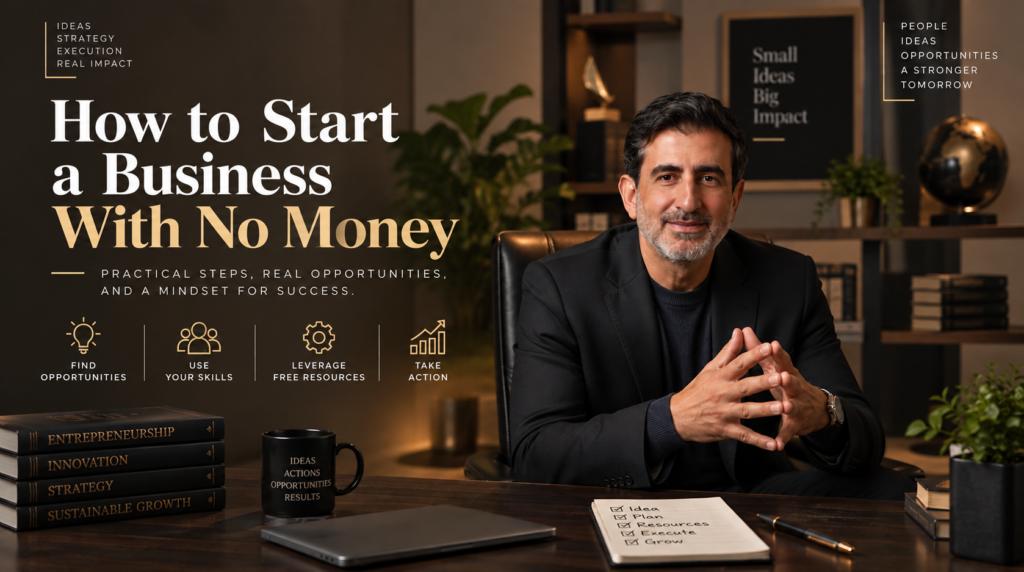
How to Start a Business With No Money
“I don’t have the capital” is one of the most common reasons people delay starting a business, and one of the least examined. Most businesses that exist today didn’t start with significant funding — they started with a founder’s time, a specific skill, and a customer willing to pay before anything elaborate was built. Learning how to start a business with no money is less about finding a shortcut around capital and more about choosing a model that doesn’t require much of it in the first place.
This covers the business models that genuinely work with little to no upfront investment, a practical sequence for getting started, and the mistakes that quietly turn a low-capital business into a cash-strapped one.
Key Takeaways
|
How to Start a Business With No Money: What It Actually Means
Almost every business requires some cost — a domain name, a basic tool, transportation to meet a first client. What “starting a business with no money” really means is choosing a model where that cost is close to zero, rather than one requiring inventory, equipment, or a facility before you can generate a single dollar of revenue.
The distinction matters because it reframes the goal. You’re not looking for a way to eliminate cost entirely — you’re looking for a business model that can start generating revenue before it requires meaningful capital.
Business Models That Work With Little Capital
These five approaches are the most realistic starting points when you want to start a business with little capital or effectively none at all.
01
Service-Based BusinessesSelling an existing skill directly, with no inventory or manufacturing required. |
02
Reselling and ArbitrageSourcing and reselling products only after a buyer is already lined up. |
03
Content and Audience-Based BusinessesBuilding a specific audience first, then monetizing through products or services. |
||
04
Marketplace and Platform ModelsUsing an existing platform’s infrastructure and traffic instead of building your own. |
05
Pre-Sold or Made-to-Order ProductsCollecting payment before production, so customer money funds the first batch. |
|||
1. Service-Based Businesses
Consulting, freelance work, coaching, and skilled trades are the most direct path to starting a business with no money, because the product is your time and expertise rather than a physical good. The only real requirement is a way to find and communicate with clients.
2. Reselling and Arbitrage
Sourcing a product only after securing a buyer — rather than purchasing inventory speculatively — removes most of the capital risk typically associated with retail or product businesses.
3. Content and Audience-Based Businesses
Building an audience around a specific topic, then monetizing through products, services, or partnerships, requires almost no capital beyond time — though it typically takes longer to produce revenue than the other models here.
4. Marketplace and Platform Models
Selling through an existing platform — rather than building a website and driving your own traffic — trades a percentage of revenue for immediate access to buyers who are already looking for what you offer.
5. Pre-Sold or Made-to-Order Products
Collecting payment or a deposit before producing a physical product means customer revenue funds production, rather than the founder’s own capital carrying the risk of unsold inventory.
A Step-by-Step Approach to Starting With No Money
The models above work best inside a disciplined sequence. Skipping steps — especially the reinvestment step — is how a low-capital start quietly becomes a cash-strapped one.
|
01
|
Turn an Existing Skill Into a Sellable OfferIdentify a skill you already have that someone would pay for today, without additional training or equipment. |
|
02
|
Get a Paying Customer Before Building Anything ExtraResist the urge to build a website, brand, or tools before someone has actually paid for the core offer. |
|
03
|
Use Free or Low-Cost Tools FirstFree-tier software and manual processes can handle most early operations before a paid upgrade is justified. |
|
04
|
Trade Skills or Barter Where RealisticExchange your expertise for something else you need — design for accounting help, for example — instead of paying cash for everything. |
|
05
|
Reinvest Early Revenue Before Paying YourselfPut early income back into the parts of the business that generate more revenue, rather than treating it as personal income immediately. |
|
06
|
Scale Spending Only as Revenue Justifies ItAdd paid tools, inventory, or help only once there’s consistent revenue to support the added cost, not in anticipation of it. |
This sequence is what it actually looks like to bootstrap a business — not avoiding all spending forever, but delaying it until revenue, not optimism, can justify it.
Bootstrapping vs. Seeking Outside Capital
Starting with no money doesn’t mean staying that way forever. It’s worth understanding the trade-offs before deciding whether to raise capital later.
| Factor | Bootstrapping | Seeking Outside Capital |
| Speed to Start | Immediate — no fundraising process required | Slower — requires pitching, negotiation, approval |
| Control | Full ownership and decision-making retained | Diluted ownership and often shared decisions |
| Risk Exposure | Limited to what you personally invest | Comes with investor expectations and obligations |
| Growth Pace | Typically slower, funded by revenue | Can be faster, funded by external capital |
| Pressure to Perform | Self-imposed, flexible timeline | Often tied to investor milestones and expectations |
Common Mistakes to Avoid
- Spending on branding before the offer is proven. A logo and a polished website rarely determine whether the first ten customers say yes.
- Buying inventory speculatively. Purchasing stock before confirming demand is one of the fastest ways to turn a no-money business into a debt-funded one.
- Treating all early revenue as personal income. Without reinvestment, a low-capital business has no path to needing less bootstrapping over time.
- Choosing a capital-intensive model out of preference. Some business ideas simply aren’t suited to a no-money start — a different, lower-capital model with similar upside is often available.
- Underpricing to compensate for lack of credibility. Charging too little to compensate for limited resources undermines the reinvestment cycle from the start.
|
“ Businesses that start with no money often build the sharpest instincts for what customers will actually pay for — there’s no cushion to hide a wrong guess. A Perspective on Bootstrapped Businesses |
Final Thoughts
Knowing how to start a business with no money comes down to choosing a model — a service, a resale arrangement, a pre-sold product — where revenue can arrive before significant cost does, and then reinvesting that revenue deliberately rather than spending it immediately.
Capital makes some things easier, but it has never been the determining factor in whether a business idea is worth pursuing. That’s decided by whether someone is willing to pay for it — which you can usually find out for close to nothing.
FAQ
Frequently Asked Questions
Can you really start a business with no money?
You can start with very little — most costs are close to zero, not literally zero. Service-based businesses, in particular, require minimal upfront investment beyond your own time and skill.
What businesses can I start with little to no capital?
Consulting, freelancing, reselling with no upfront inventory, content-based businesses, and pre-sold or made-to-order products are the most accessible starting points.
How do you get customers before you have money to market?
Direct outreach, existing personal and professional networks, and free platforms with built-in audiences typically outperform paid marketing in the earliest stage of a low-capital business.
Do I need a business loan to start a business with no money?
Not necessarily. Many low-capital business models are specifically chosen to avoid the need for a loan; borrowing is more often relevant once a proven model is ready to scale.
What’s the fastest way to bootstrap a business?
Selling a service you can already deliver, to a customer you can reach directly, is typically the fastest path — it skips product development, inventory, and most marketing costs entirely.
Can I start a business with no money and no experience?
Yes, though it’s worth starting with a skill or interest you already have some familiarity with, rather than an entirely unfamiliar field, to reduce the number of unknowns you’re managing at once.
What expenses are truly unavoidable even with no capital?
Basic legal registration where required, a way to accept payment, and minimal communication tools are typically the only unavoidable costs, and most have low-cost or free options available.
Is it better to start with no money or wait until I’ve saved more?
Starting sooner with a low-capital model usually produces more useful information than waiting, since real customer feedback tends to matter more than a larger starting budget