
Business Decision-Making Frameworks Every Leader Should Know
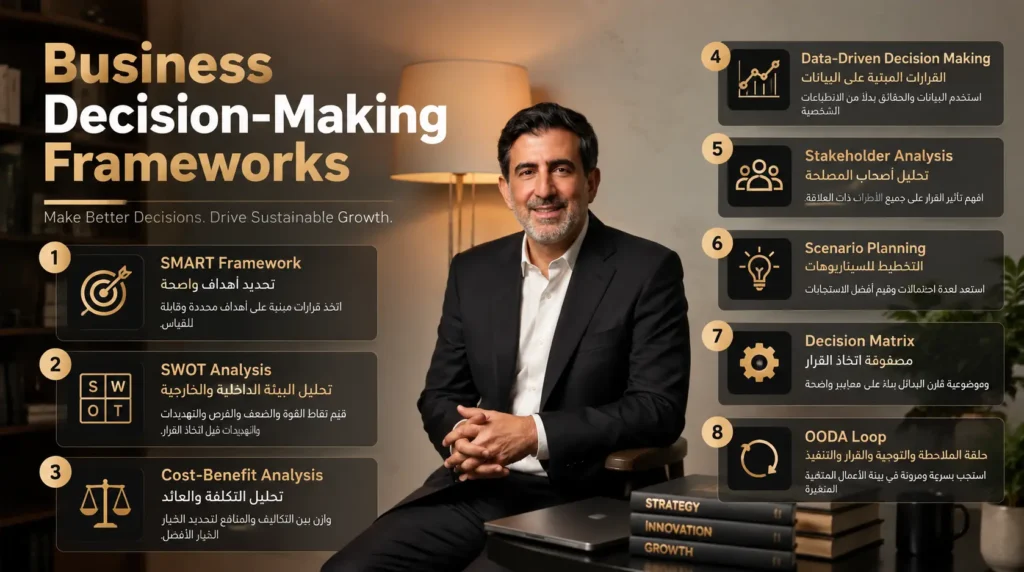
Eleven proven frameworks for making faster, clearer, and more defensible decisions, with guidance on when to use each one in a Saudi market shaped by Vision 2030.
Samer Choucair, investment entrepreneur
A leadership team in Riyadh debates whether to open a second branch in Jeddah. The meeting runs two hours. Everyone has an opinion, the most senior voice prevails, and three months later nobody can explain why the decision was made, what was expected to happen, or how to tell whether it worked. The problem was never a lack of intelligence in the room. It was the absence of a structured way to decide.
Business decision-making frameworks solve exactly this. They turn decisions from debates about opinions into a disciplined process: clarifying the real question, comparing options against agreed criteria, exposing hidden risks, and assigning clear ownership. In Saudi Arabia, where Vision 2030 continues to reshape sectors, open new markets, and raise expectations of corporate governance, that discipline has become a competitive advantage rather than a management nicety.
This guide, part of the Entrepreneurial Mindset series on the Samer Choucair platform, explains eleven decision-making frameworks for business, grouped by the job they do: understanding the situation, making strategic choices, comparing options, deciding at the right speed, assigning accountability, and reducing bias. You will also find a selection guide, a five-step decision process, and practical notes on applying these business decision models in the Saudi context.
Key Takeaways
- Definition: A business decision-making framework is a structured method for analyzing options, risks, and trade-offs so that decisions are consistent, explainable, and aligned with strategy.
- Match the framework to the decision: No single model fits every situation. Diagnose whether the decision is simple, complicated, complex, or chaotic before choosing a tool.
- Separate reversible from irreversible: Reversible decisions should be made quickly by the people closest to the work. Irreversible ones deserve deeper analysis and senior ownership.
- Clarify who decides: Many decisions stall not because the analysis is hard but because nobody knows who has the final say. Accountability frameworks fix this.
- Design against bias: Tools such as the pre-mortem and second-order thinking counter overconfidence, groupthink, and short-term thinking.
- Context matters in Saudi Arabia: Rapid regulatory change, new sectors opened by Vision 2030, and rising governance standards make structured decisions more valuable, not less.
In this article
- What Are Business Decision-Making Frameworks?
- Why Structured Decisions Matter in Saudi Arabia Today
- 11 Business Decision-Making Frameworks Every Leader Should Know
- How to Choose the Right Business Decision Model
- A Five-Step Decision Process for Leadership Teams
- Applying Decision Frameworks in the Vision 2030 Era
- Common Decision-Making Mistakes
- Decision Quality Checklist
- Frequently Asked Questions
- Conclusion
What Are Business Decision-Making Frameworks?
Definition
Business decision-making frameworks are structured methods that help leaders define a decision, generate and compare options, evaluate risks and trade-offs, and assign responsibility for the outcome. They do not make decisions on a leader’s behalf. They make the reasoning visible, so that decisions can be explained, challenged, improved, and learned from.
Why frameworks outperform instinct alone
Experienced leaders develop valuable intuition, and frameworks are not meant to replace it. But intuition is shaped by past situations and is vulnerable to well-documented cognitive biases, a field popularized by researchers such as Daniel Kahneman and Amos Tversky. Overconfidence, anchoring on the first number mentioned, and favoring information that confirms existing views all quietly distort business choices. A framework introduces checkpoints where those distortions can be caught.
What a good decision looks like
A good decision is not the same as a good outcome. Markets move, competitors react, and luck plays a role. A good decision is one made with a clear objective, relevant information, genuine alternatives, an honest view of risk, and a named owner. Judging decisions by process rather than results alone is what allows a leadership team to learn instead of simply celebrating wins and blaming losses.
|
Clarity before analysis Most poor decisions start with the wrong question. Defining the decision precisely is often half the work. |
Speed is a strategic asset Slow decisions have costs too. The right framework helps you decide as fast as the situation allows, and no slower. |
|
Ownership ends debate A decision without a single accountable owner tends to be revisited endlessly or quietly ignored. |
Process over outcome Evaluate decisions by the quality of the reasoning, so the organization learns from both successes and failures. |
Why Structured Decisions Matter in Saudi Arabia Today
Since its launch in 2016, Saudi Vision 2030 has set out to diversify the economy, expand the role of the private sector, and grow sectors such as tourism, entertainment, technology, logistics, and advanced manufacturing. For business leaders, this creates an unusual combination of opportunity and uncertainty: new markets are opening quickly, regulations are being modernized, and competition, including from international entrants, is intensifying.
In that environment, decisions carry higher stakes and shorter windows. Leaders must decide which new sectors to enter, how fast to localize talent, when to digitize operations, and how to meet rising expectations of corporate governance and transparency. Many established family-owned businesses are also transitioning toward more institutional governance, where decisions need to be documented and defensible rather than resting on one individual’s judgment. Business decision-making frameworks provide the structure these transitions require.
11 Business Decision-Making Frameworks Every Leader Should Know
The frameworks below are grouped by the job they do in the decision process. Most leaders will not use all of them, but knowing the full set allows you to choose deliberately rather than defaulting to the same tool every time.
Understanding the situation
| 01 |
The Cynefin FrameworkDeveloped by Dave Snowden, Cynefin helps leaders identify what kind of situation they face before deciding how to act. Simple (or clear) situations have obvious answers and call for best practice. Complicated situations require expert analysis. Complex situations, where cause and effect are only clear in hindsight, call for small experiments. Chaotic situations demand immediate action to restore stability. Many costly mistakes come from treating a complex market entry as if it were a complicated engineering problem with a single right answer. In practice: Before any major decision, ask your team which of the four domains you are in. If opinions differ, that disagreement is itself a valuable signal. |
| 02 |
SWOT AnalysisSWOT maps internal strengths and weaknesses against external opportunities and threats. It is widely used and often criticized for producing generic lists, but it becomes useful when each item is specific, evidence-based, and linked to a decision. Its real value is in the connections: which strengths can capture which opportunities, and which weaknesses leave you exposed to which threats. In practice: Limit each quadrant to three to five specific points, then write down the two or three strategic options the analysis actually suggests. |
Making strategic choices
| 03 |
Scenario PlanningScenario planning, closely associated with its long-standing use at Shell, prepares leaders for multiple plausible futures rather than a single forecast. Teams identify the most important uncertainties affecting the business, build three or four distinct scenarios, and test how each strategic option performs across them. The goal is not to predict the future but to choose strategies that remain robust as conditions change. In practice: Identify the two uncertainties with the biggest impact on your business, combine them into four scenarios, and check whether your preferred strategy survives in each. |
| 04 |
Cost-Benefit and NPV AnalysisCost-benefit analysis compares the expected costs of an option with its expected benefits. For investment decisions, Net Present Value (NPV) refines this by discounting future cash flows to reflect the time value of money and the risk involved. These tools bring financial discipline to choices such as new facilities, technology investments, or acquisitions, provided the assumptions behind the numbers are made explicit and tested. In practice: Always run a conservative case alongside the base case, and identify which single assumption, if wrong, would change the decision. |
Comparing options
| 05 |
The Weighted Decision MatrixA weighted decision matrix lists options in rows and decision criteria in columns. Each criterion receives a weight reflecting its importance, each option is scored against each criterion, and the weighted totals are compared. It is particularly useful for choices with several competing factors, such as selecting a supplier, a technology platform, or a location for expansion. In practice: Agree on criteria and weights before scoring any option. Changing weights after seeing the results is a common way to rationalize a decision already made. |
| 06 |
The Pareto PrincipleThe Pareto principle, often summarized as the 80/20 rule, suggests that a small share of causes typically drives a large share of results. It is a heuristic rather than a precise law, but it is powerful for prioritization: identifying the few customers, products, or problems that matter most before allocating time and capital. In practice: Rank your customers, products, or issues by their impact, and focus the decision on the small group at the top of the list. |
Deciding at the right speed
| 07 |
One-Way and Two-Way DoorsPopularized by Jeff Bezos in his letters to Amazon shareholders, this model separates decisions into two types. One-way doors are difficult or impossible to reverse and deserve careful, senior deliberation. Two-way doors can be reversed if they turn out to be wrong, so they should be made quickly, often by people closer to the work. Treating every decision as a one-way door is one of the most common causes of slow organizations. In practice: Label each pending decision as reversible or irreversible. Delegate reversible ones and set a short deadline for them. |
| 08 |
The OODA LoopDeveloped by military strategist John Boyd, the OODA loop describes decision-making as a continuous cycle of Observe, Orient, Decide, and Act. Its central insight is that in competitive environments, the organization that completes this cycle faster and more accurately than its rivals gains an advantage. It is especially relevant in fast-moving markets where conditions change before a full analysis can be completed. In practice: For time-sensitive decisions, define a short review rhythm, observe the results of each action, and adjust quickly rather than waiting for complete information. |
Assigning accountability
| 09 |
The RAPID Decision ModelDeveloped by Bain & Company, RAPID clarifies decision roles: who Recommends a course of action, who must Agree, who provides Input, who Decides, and who will Perform the work. Its strength is that it identifies a single person with the “D”, ending the ambiguity that leaves important decisions circulating between departments. In practice: For your next major cross-functional decision, write down the five RAPID roles before the first meeting and share them with everyone involved. |
Reducing bias
| 10 |
The Pre-MortemProposed by psychologist Gary Klein, the pre-mortem asks the team to imagine that the decision has already been implemented and has failed, then to explain why. This simple reversal gives people permission to voice concerns they might otherwise keep to themselves, and it surfaces risks that optimistic planning tends to overlook. In practice: Before approving a major decision, give the team ten minutes to write down independently the most likely reasons it could fail, then address the top risks. |
| 11 |
Second-Order ThinkingFirst-order thinking asks what will happen immediately. Second-order thinking asks what will happen next, and after that. A price cut may increase sales this quarter, but it may also train customers to wait for discounts and invite a competitive response. Considering second and third-order effects helps leaders avoid decisions that solve today’s problem by creating a larger one later. In practice: For each option, ask “and then what?” at least twice, and note the consequences for customers, competitors, employees, and cash flow. |
Editorial Insight
A framework does not make the decision for you. It makes your reasoning visible, so that it can be questioned before the market questions it for you.
How to Choose the Right Business Decision Model
Choosing a framework is itself a decision. This guide matches common business situations with the business decision models that tend to fit them best:
| Situation | Recommended frameworks | Why |
|---|---|---|
| Unclear what kind of problem you face | Cynefin | Determines whether to analyze, experiment, or act immediately |
| Annual strategy or market entry | SWOT, Scenario Planning | Connects internal capabilities to external uncertainty |
| Capital investment or acquisition | Cost-Benefit, NPV, Pre-Mortem | Adds financial discipline and exposes hidden risks |
| Choosing between several options | Weighted Decision Matrix | Makes criteria and trade-offs explicit |
| Too many priorities, limited resources | Pareto Principle | Focuses effort where impact is highest |
| Organization feels slow | One-Way and Two-Way Doors | Speeds up reversible decisions and protects critical ones |
| Fast-changing competitive situation | OODA Loop | Rewards rapid cycles of action and learning |
| Decisions stalling across departments | RAPID | Assigns a single clear decision owner |
| Risk of short-term thinking | Second-Order Thinking | Reveals downstream consequences |
A Five-Step Decision Process for Leadership Teams
Frameworks work best inside a consistent process. This five-step sequence can be applied to any significant decision, with individual frameworks plugged into the relevant step:
| 01 |
Frame the decision Define the exact question, the objective, the deadline, and whether the decision is reversible. Use Cynefin to understand the context. |
| 02 |
Generate real options Develop at least three genuine alternatives, including the option of doing nothing. Use SWOT or scenario planning to widen the view. |
| 03 |
Evaluate trade-offs Compare options against agreed criteria and test the financial case. Use a weighted matrix, cost-benefit, or NPV analysis. |
| 04 |
Stress-test and decide Run a pre-mortem, apply second-order thinking, confirm the decision owner with RAPID, then commit. |
| 05 |
Communicate, execute, and review Explain the decision and its reasoning, assign execution owners, and schedule a review date to compare results with expectations. |
Practical note
Keep a simple decision log recording the question, options considered, the choice made, the reasoning, and the expected outcome. Reviewing it every quarter is one of the most effective ways for a leadership team to improve its judgment over time.
Applying Decision Frameworks in the Vision 2030 Era
The principles above are universal, but the Saudi market adds specific considerations for leaders applying decision-making frameworks for business:
- Entering newly opened sectors: tourism, entertainment, sports, and other sectors expanding under Vision 2030 are often complex rather than complicated. Cynefin suggests starting with small, measurable pilots before committing large capital.
- Building scenarios around policy and regulation: regulations are being modernized across many areas, from commercial and investment rules to labor and localization requirements. Scenario planning should treat regulatory change as a key variable, and leaders should verify current requirements with the relevant authorities before acting.
- Aligning with national priorities: decisions that support localization, digital transformation, and private sector participation may open access to partnerships and programs. Including alignment with national priorities as a weighted criterion in decision matrices can surface these opportunities.
- Strengthening governance: as companies grow, seek investment, or prepare for possible listing, documented decision processes and clear decision rights become increasingly important. RAPID and decision logs support this shift.
- Balancing consultation and speed: consultation and consensus are valued in many Saudi organizations. Frameworks such as RAPID preserve meaningful input while still identifying who makes the final call, so consultation does not become delay.
- Using data responsibly: the national push toward data-driven government and digital services raises expectations that business decisions will also be grounded in data rather than assumption.
Important
Policies, incentives, and regulatory requirements in Saudi Arabia are updated regularly. Treat any specific requirement or program as something to confirm with the relevant government authority or a qualified local advisor at the time of the decision.
Common Decision-Making Mistakes
| ✕ |
Solving the wrong problemJumping to options before defining the real question leads to well-analyzed answers to the wrong decision. |
| ✕ |
Considering only one optionA decision framed as “yes or no” hides alternatives that might be better than either. |
| ✕ |
Letting seniority replace evidenceWhen the most senior voice ends every debate, teams stop sharing information that might challenge it. |
| ✕ |
Analysis paralysisApplying deep analysis to reversible decisions slows the organization without improving results. |
| ✕ |
Unclear decision ownershipDecisions without a single owner are revisited repeatedly, implemented inconsistently, or quietly abandoned. |
| ✕ |
Never reviewing past decisionsWithout comparing outcomes to the original reasoning, leadership teams repeat the same errors. |
Decision Quality Checklist
- ☐The decision question is written clearly in one sentence.
- ☐We know whether the decision is reversible or irreversible.
- ☐At least three genuine options were considered.
- ☐Criteria and their weights were agreed before options were scored.
- ☐Key assumptions are explicit, and a conservative case was tested.
- ☐A pre-mortem identified the main risks and how to address them.
- ☐Second-order effects on customers, competitors, and cash flow were considered.
- ☐One person is clearly accountable for the final decision.
- ☐Relevant regulatory requirements were verified with official sources.
- ☐A review date is set to compare results with expectations.
Frequently Asked Questions About Business Decision-Making Frameworks
What are business decision-making frameworks?
Business decision-making frameworks are structured methods that help leaders define decisions, compare options, evaluate risks, and assign accountability. Common examples include Cynefin, SWOT analysis, scenario planning, the weighted decision matrix, the OODA loop, the RAPID model, and the pre-mortem.
What is the best decision-making framework for business?
There is no single best framework. The right choice depends on the decision. Cynefin helps diagnose the situation, scenario planning supports strategy under uncertainty, weighted matrices compare options, RAPID clarifies ownership, and the pre-mortem reduces risk before commitment.
What is the difference between a decision-making framework and a business decision model?
The terms are often used interchangeably. A framework usually describes a broader structured approach to thinking through a decision, while a model often refers to a specific tool or method, such as a decision matrix or NPV calculation, used within that approach.
How do leaders make decisions under uncertainty?
They first identify the type of uncertainty, often using Cynefin, then use scenario planning to test options across several possible futures, favor reversible steps and small pilots where possible, and review results frequently using a cycle such as the OODA loop.
How can decision-making frameworks support Vision 2030 goals?
They help Saudi businesses evaluate opportunities in newly opened sectors, plan around regulatory change, align investments with national priorities such as localization and digital transformation, and strengthen the governance and transparency expected as companies grow.
How do you speed up decision-making in an organization?
Separate reversible from irreversible decisions, delegate reversible ones to the people closest to the work, assign a single decision owner using a model such as RAPID, and set clear deadlines for each decision.
How can leadership teams reduce bias in decisions?
Use structured tools such as the pre-mortem, agree on criteria before evaluating options, invite independent views before group discussion, apply second-order thinking, and review past decisions to learn from both successes and failures.
Conclusion
Business decision-making frameworks give leaders something intuition alone cannot: a shared, visible, and repeatable way to reason through important choices. Cynefin clarifies the situation, SWOT and scenario planning shape strategy, decision matrices and financial analysis compare options, one-way and two-way doors set the right speed, RAPID assigns ownership, and the pre-mortem and second-order thinking guard against bias.
For leaders in Saudi Arabia, the case is especially strong. As Vision 2030 continues to open sectors, modernize regulation, and raise governance expectations, the organizations that decide well, quickly, and transparently will be best positioned to capture opportunity. Start with one framework on your next significant decision, record the reasoning, and review it when the results arrive.
Samer Choucair
Entrepreneur and investor writing about entrepreneurship, investment, strategic thinking, and business growth in the Arab world.