
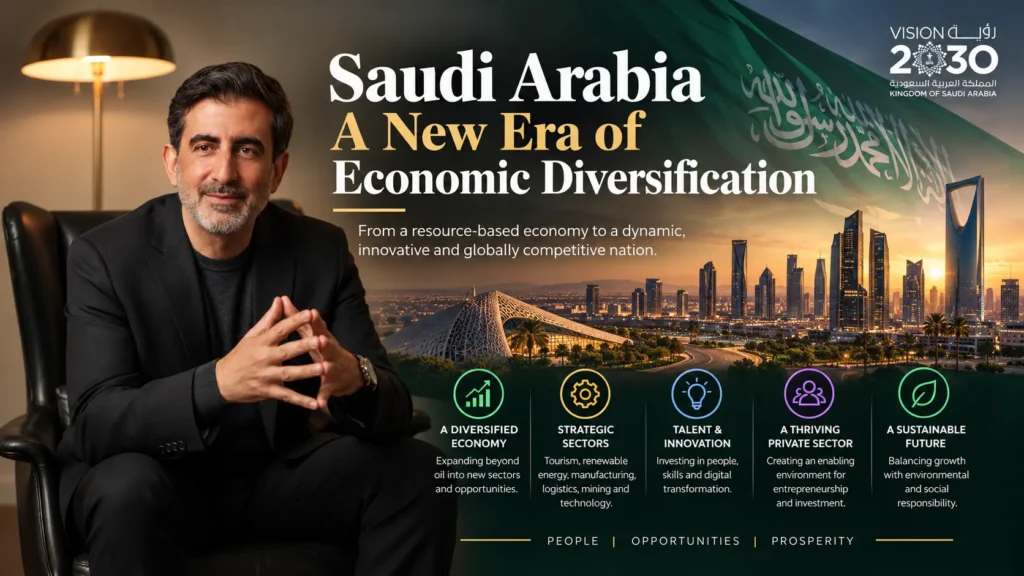
Saudi Arabia A New Era of Economic Diversification
Investment Perspectives on Growth Sectors Risk and Long Term Value
Samer Choucair
During a televised interview, the presenter asked me:
When you said that Saudi Arabia was not merely diversifying its income but building multiple engines of growth, do you still hold that view after the developments witnessed in 2026? Which three engines would you back over the next decade?
When we discuss the Saudi economy today, we are looking at an economy undergoing a fundamental shift in the sources of its growth. Non-oil activities now account for approximately 55% of the economy and recorded growth of 4.9% in 2025.
More important than the figures themselves is what this transformation means for investors. The question is no longer simply how large the economy has become. The real question is which sectors can scale, generate profits, and produce sustainable cash flow.
In my view, three major growth engines deserve close attention: industry and logistics, tourism, and technology.
How Should Investors Respond to Falling Oil Prices
A 40% decline in oil prices would not necessarily cause the Saudi economy to collapse. It would, however, require investors to reassess their assumptions.
According to the figures cited in this article, non-oil activities account for approximately 55% of the economy, while oil still contributes around 54.5% of government revenue.
The 2025 budget deficit also reached approximately SAR 276.6 billion. This makes disciplined management of liquidity, costs, debt, and financial commitments increasingly important for companies and investors alike.
Higher Oil Prices Can Create Investment Opportunities
Rising oil prices have two very different effects.
On one hand, they can strengthen government revenue and support spending on infrastructure and major projects. On the other, they can increase liquidity and push the prices of certain assets higher at a faster rate than the growth of their underlying profits.
Investors must therefore avoid confusing stronger economic conditions with the attractiveness of every investment asset.
Industry and Logistics as an Investment Opportunity
I believe industry and logistics deserve particular attention, especially as Saudi Arabia expands its non-oil economy and strengthens its export capabilities.
According to the figure cited in this article, non-oil exports reached approximately SAR 624 billion in 2025.
This creates opportunities extending far beyond the construction of factories. It opens markets for suppliers, industrial maintenance, transportation, warehousing, inventory management, technical services, and export support.
Tourism Growth Does Not Guarantee the Success of Every Tourism Project
Saudi Arabia’s tourism sector has expanded significantly.
According to the figures cited here, the Kingdom welcomed approximately 123 million visitors in 2025, while tourism spending reached nearly SAR 304 billion and foreign direct investment rose to approximately $35.5 billion.
These numbers are encouraging, but investors must distinguish between the growth of an entire sector and the success of an individual project.
A rapidly expanding tourism market does not automatically guarantee that every hotel, resort, or entertainment venture will generate an attractive return.
Moving from Building Assets to Generating Returns
I believe the Saudi economy is entering an important stage of its transformation. The focus is gradually shifting from constructing infrastructure and accumulating assets to maximizing their productive and commercial value.
A port does not achieve its full economic potential simply because construction has been completed. Its real value emerges when it facilitates trade, reduces transportation costs, accelerates the movement of goods, and strengthens supply chains.
The same principle applies to industrial cities, logistics zones, tourism destinations, and digital infrastructure. The next stage is about turning completed assets into production, services, exports, and recurring revenue.
How Should an Investor Choose the Right Property
The Saudi real estate market offers a wide range of opportunities, but that does not mean every property purchase will be successful.
Consider two properties, each valued at SAR 10 million. The first generates annual net income of SAR 400,000, while the second produces SAR 700,000.
The first delivers a net yield of approximately 4%, while the second generates around 7%, before accounting for additional differences in risk, financing, location, or future growth.
This example illustrates why investors should compare actual income rather than relying solely on a property’s price, reputation, or location.
A valuable property is not necessarily the one whose price rises fastest. It is the one whose purchase price is justified by its income, risks, and long-term growth potential.
Tourism Investment Extends Beyond Hotel Ownership
Tourism investment should not be limited to hotels and resorts.
The tourism ecosystem also includes transportation, restaurants, entertainment experiences, reservations, digital services, trip management, cultural activities, and specialist support services.
In some cases, these businesses may offer greater flexibility than a large property-based investment requiring substantial capital and carrying high fixed operating costs.
The opportunity lies in identifying what visitors still need and building a service capable of meeting that demand at the right quality and price.
Is Artificial Intelligence a Genuine Opportunity or an Investment Bubble
Artificial intelligence may represent a genuine technological revolution, but it can also produce inflated investment valuations.
This pattern is not new. The internet fundamentally changed the world, yet many investors lost money by purchasing technology companies at excessive prices, even when the underlying innovation was transformative.
The importance of a technology must always be separated from the attractiveness of a particular investment.
When I assess an artificial intelligence company, I ask three essential questions:
First, does it have customers who are willing to pay?
Second, can it generate healthy margins after accounting for computing, operating, and development costs?
Third, does the investment price leave room for a future return, or does it already reflect extremely optimistic expectations?
A Saudi company developing artificial intelligence solutions to improve warehouse management, reduce waste, or increase industrial efficiency could be promising if it demonstrates measurable savings for its customers.
By contrast, a company with an impressive presentation but no paying clients does not become a sound investment simply because it operates in artificial intelligence.
The technology may be revolutionary, but a successful investment still requires a sustainable business model.
How Can Saudi Arabia Become a Centre for Technology and Innovation
Saudi Arabia possesses several advantages that could support the expansion of its technology sector, including energy resources, geographic position, domestic demand, infrastructure, and large-scale investment in economic transformation.
Turning these advantages into an influential technology ecosystem requires more than importing equipment or hosting international companies. It requires building Saudi companies capable of developing products and services that compete internationally.
If a Saudi company develops an artificial intelligence platform that helps hospitals improve resource allocation or operating efficiency, then successfully exports that platform to markets across the Gulf, Asia, and Europe, it has created a scalable technology business.
If the activity is limited to importing equipment and reselling it domestically, it may still generate commercial returns, but it does not necessarily create an export-driven technology industry.
The objective is not to replicate Silicon Valley. It is to build an innovation ecosystem shaped by Saudi Arabia’s own competitive advantages and capable of competing globally.
What Does a Global Investor Look for in Saudi Arabia
When international investors assess a new market, they look beyond its size.
They study the customer base, production costs, access to regional and global markets, logistics efficiency, regulatory stability, and the clarity of operating procedures.
Saudi Arabia offers significant advantages, including a large domestic market, strategic geographic positioning, modern infrastructure, and industrial and logistics zones that can reduce transportation and distribution costs.
These advantages become more valuable when they generate measurable commercial outcomes, such as faster delivery, greater operating efficiency, lower costs, and easier access to regional and international customers.
Investment incentives also vary by sector, location, licence, and programme. Investors must examine the conditions relevant to their activities instead of assuming that the same incentives apply to every project.
Ultimately, investors seek an environment that enables them to generate sustainable returns, not one that provides only temporary incentives.
How Would I Invest One Million Dollars in the Saudi Market
If I had $1 million to invest, I would not begin by selecting a project or stock. I would first determine what that amount represents within my total wealth.
Does it represent my entire net worth or only a limited portion of a diversified portfolio? Will I need access to the capital soon, or can I invest it for several years?
If the amount represents my entire wealth, the priority would be liquidity, risk management, and avoiding excessive concentration in a single asset.
If it represents a smaller portion of a broader portfolio, a larger allocation to higher-risk, long-term growth investments may be appropriate.
A general allocation could include liquid assets, listed companies with transparent cash flows, and a smaller position dedicated to long-term growth, depending on the investor’s objectives and capacity to absorb losses.
Within the Saudi market, I would pay particular attention to companies operating in industry, services, and non-oil activities. I would closely examine their revenue, debt, margins, cash generation, and market valuation.
I would not invest in a company merely because it is Saudi, nor would I enter a project simply because it aligns with a promising economic trend.
I would avoid businesses with unclear profit engines, long-term assets funded through short-term debt, and investments that only make sense if asset prices continue rising.
If the only expected source of profit is selling the investment later at a higher price, without income or clear economic value supporting it, I would proceed with considerable caution.
The objective is to build a portfolio suited to the investor’s needs, not to search for one investment expected to achieve everything.
The Opportunities Behind the Headlines
Investors often focus on large, highly publicized projects. Yet some of the most compelling opportunities may lie in companies providing essential services behind the scenes.
These include industrial maintenance, inventory management, customs clearance, spare parts, operational training, specialist logistics, and technical services.
As industry and exports expand, businesses require a broad network of suppliers and service providers capable of supporting operations and improving efficiency.
Consider an investor choosing between building a major factory and establishing an industrial maintenance company serving ten factories through recurring annual contracts.
If executed effectively, the maintenance company could benefit from recurring cash flow, lower capital requirements, and a relatively diversified client base.
That does not mean a smaller service company is always superior to a factory. The decision depends on contracts, margins, costs, competition, and customer concentration.
In many cases, the greatest opportunity is not the construction of a massive asset, but the delivery of an indispensable service to a large number of existing assets.
Mining and the Value Beyond Extraction
Mining can make a significant contribution to economic diversification, but the investment opportunity extends beyond extracting raw materials.
Additional value can be created through processing, manufacturing, equipment supply, maintenance, engineering services, transportation, and technologies that improve mining efficiency.
When raw material is transformed into a higher-value industrial product, more stages of the value chain remain within the economy, creating jobs, expertise, and export opportunities.
Mining projects, however, often require substantial capital, long development periods, and exposure to commodity price volatility and operating costs.
Investors must assess the quality of the resource, production costs, infrastructure, access to customers, and the project’s ability to withstand changing market conditions.
The essential question is whether the project remains economically viable when commodity prices decline, or whether its success depends on exceptional market conditions.
A strong project is one that can withstand different market cycles, not one that generates attractive returns only under ideal circumstances.
How Do I Evaluate a Company Before Investing
When assessing a company, I focus on several financial and operating indicators.
First, free cash flow. This is the cash remaining after the company has covered its operating expenses and the capital investment required to sustain its business.
Second, return on invested capital and how it compares with the company’s cost of capital. If the return falls below the cost of funding and risk, growth does not necessarily create value for shareholders.
Third, the company’s ability to meet its financial obligations if earnings decline.
I also examine customer concentration. If half or more of the company’s revenue comes from a single customer, losing that relationship could have a severe effect on performance.
For startups, it is important to compare customer acquisition cost with the total profit a customer may generate throughout the relationship.
For artificial intelligence companies, investors should assess revenue after deducting computing, operating, and development costs rather than focusing on headline revenue alone.
An investment is not attractive merely because its story is compelling. Its numbers must withstand difficult questions.
What Does Genuine Industrial Localization Mean
Genuine localization is not limited to assembling part of a product domestically and describing the activity as national manufacturing.
Meaningful localization includes developing skills, building a network of local suppliers, transferring engineering knowledge, expanding manufacturing capabilities, and participating in product development.
International investors can contribute through partnerships involving component manufacturing, technical testing, maintenance, training, and the development of Saudi capabilities.
Knowledge acquired in advanced sectors can also be transferred into civilian and commercial activities, widening the country’s technical and industrial base.
Successful localization requires sustainable demand, clear contracts, and products capable of competing on both quality and price.
If a company depends entirely on one contract and cannot survive without it, its ability to establish an independent industrial business remains limited.
The objective is not merely to increase the percentage of local components. It is to build productive capabilities that can survive, evolve, and compete.
What Makes Saudi Arabia a Distinctive Investment Destination
I believe three principal factors support Saudi Arabia’s investment appeal.
The first is the scale and diversity of domestic demand, including consumer, service, industrial, and tourism activity, alongside the unique demand generated by the Two Holy Mosques and religious tourism.
The second is the Kingdom’s geographic location, energy resources, and expanding infrastructure, all of which can support industry, trade, and logistics.
The third is the economic transformation opening new sectors and enabling business models that were previously unavailable at the same scale.
These advantages do not guarantee that every project will succeed or that every asset will appreciate.
Investors still require appropriate returns, clear regulations, efficient business procedures, and transparent routes for entering and exiting an investment.
The strength of the Saudi market does not lie in the absence of risk. It lies in the presence of opportunities worthy of disciplined analysis within a clear risk management framework.
Does Geographic Location Create a Competitive Advantage
Geographic position can be a powerful advantage, but it does not automatically translate into profits.
Its value depends on delivery speed, transportation costs, procedural efficiency, service reliability, and the ability to connect ports, industrial zones, warehouses, and transport networks within one integrated system.
Goods may pass through a strategically located market, but slow procedures or high costs can erode much of that advantage.
This creates opportunities in warehousing, inventory management, shipping, maintenance, specialist logistics, and digital technologies that reduce delays and improve operating efficiency.
Global supply chain disruptions may also create opportunities for certain companies. At the same time, they can raise insurance, shipping, and operating costs.
The real opportunity is not simply being located near an important trade route. It is building services that are faster, more reliable, and more efficient.
Can Saudi Arabia Become a Global Investment Management Centre
It is important to distinguish between a country that attracts investment and one that becomes a centre from which capital, assets, and global investments are actively managed.
Becoming an international investment management hub requires more than capital inflows. It requires deep financial markets, sophisticated asset management capabilities, experienced professionals, trusted institutions, clear regulations, efficient dispute resolution, and access to regional and global opportunities.
Saudi Arabia possesses many of the foundations required to advance in this direction. The next challenge is to strengthen the ecosystem that enables investment decisions, portfolio management, capital raising, and international transactions to be conducted from within the Kingdom.
Where Are the New Opportunities for Young People and Entrepreneurs
I believe many of the strongest opportunities lie in companies capable of converting existing infrastructure and investment into products and services that can be exported.
Young entrepreneurs should not limit their ambitions to launching another consumer application or copying an established business model.
They should examine the needs emerging around factories, logistics networks, tourism destinations, healthcare systems, mining operations, and digital infrastructure.
The next generation of Saudi companies could be built by solving practical problems, improving productivity, reducing costs, and creating services that can scale beyond the domestic market.
How Do I See the Future of Investment in Saudi Arabia
Saudi Arabia is not seeking merely to remain a market that consumes the world’s products.
It is working to expand its capacity to manufacture, deliver services, develop technology, and export.
For investors, this transition creates opportunities across the entire value chain, from large projects and listed companies to suppliers, specialist service providers, technology platforms, and emerging businesses.
The strongest opportunities will not necessarily be the loudest or most visible. They will be the businesses capable of turning economic transformation into sustainable revenue, defensible margins, and long-term value.
Investing in People Young Talent and Women
I believe investing in people is no less important than investing in factories, infrastructure, or real estate.
According to the figures cited in this article, women’s participation in the labour market increased from 22.8% in 2016 to 34.5% in the second quarter of 2025.
This expansion strengthens the talent pool, increases household participation in the economy, and broadens the base of leadership and entrepreneurship.
Lubna Olayan offers a powerful example of leadership, governance, and long-term decision-making.
Economic transformation cannot be sustained through capital alone. It requires skills, discipline, institutional knowledge, and leaders capable of making decisions whose value may take years to become fully visible.
My Message to Arab Investors
My advice to Arab investors is to place the Saudi market among the important markets deserving serious study.
One question I regularly ask myself is this:
If I received the full value of my investment back in cash today, would I purchase the same investment again at its current price?
That question forces the investor to separate emotional attachment from rational judgment.
My message to young people and investors is equally direct. Knowledge, financial analysis, capital protection, and the ability to distinguish a genuine opportunity from market noise are essential foundations for building wealth.
Wealth is rarely created through one dramatic decision.
It is built through a disciplined sequence of sound decisions, repeated consistently over time.