
Entrepreneur vs. Business Owner: What’s the Difference
Entrepreneurial Mindset
A clear guide to the entrepreneur vs business owner question across goals, innovation, risk, growth, and funding, with a comparison table and practical examples to help you choose the path that fits you.
Samer Choucair, investment entrepreneur
A successful bakery owner in a quiet neighborhood, and a young founder who launched an app connecting bakeries with customers in several cities. Both own a business, and both carry responsibility for their decisions, yet their thinking, goals, and appetite for risk are completely different. That contrast sits at the heart of the entrepreneur vs business owner debate, and it is a question many young people ask before they start.
Understanding the entrepreneur vs business owner distinction is not a debate about labels. It is a practical decision that shapes the kind of company you build, the funding that suits it, the skills you need, and how you measure success. Much of the frustration in early-stage businesses comes from someone building a traditional business while judging themselves by startup standards, or the reverse.
This guide, part of the Entrepreneurial Mindset series on the Samer Choucair platform, explains the difference between entrepreneur and business owner, offers a full entrepreneur vs business owner comparison table, breaks down eight key differences in detail, shares real-world examples, helps you decide which path fits you, and outlines how to move from business owner to entrepreneur if you choose to.
Key Takeaways
- Short answer: In the entrepreneur vs business owner comparison, an entrepreneur builds a business around a new idea or innovative model aimed at growth and scale, while a business owner runs an established model aimed at stable income.
- Innovation: Entrepreneurs change how a problem is solved; business owners deliver a proven solution with better quality, location, or service.
- Risk: Entrepreneurs accept higher risk for a larger potential return; business owners prefer calculated risk and steadier income.
- Growth: Entrepreneurs design for rapid scale; business owners usually grow gradually and steadily.
- Neither is better: The entrepreneur vs business owner choice has no universal winner. Both paths can succeed, and the right one depends on your goals and circumstances.
In this article
- Entrepreneur vs business owner: The Short Answer
- Who Is an Entrepreneur and Who Is a Business Owner?
- Entrepreneur vs business owner: Comparison Table
- Eight Differences in the Entrepreneur vs business owner Debate
- Entrepreneur vs business owner: Real-World Examples
- Which Path Is Right for You?
- Common Entrepreneur vs business owner Myths
- How to Move From Business Owner to Entrepreneur
- Entrepreneur vs business owner in the Saudi Market
- Frequently Asked Questions
- Conclusion
Entrepreneur vs business owner: The Short Answer
Short Answer
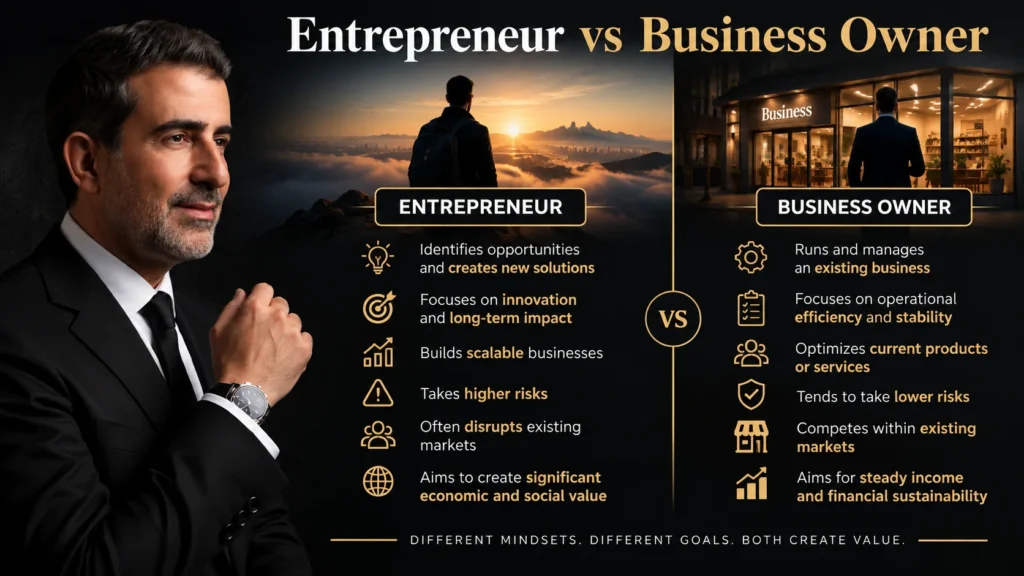
The difference between entrepreneur and business owner lies in goals and mindset. An entrepreneur looks for a problem that has not been solved well, builds a new solution or a different model for it, and accepts high risk in pursuit of rapid growth and scale. A business owner chooses a known, proven activity and runs it efficiently to generate stable income and gradual growth. Both own their businesses and carry the outcomes, but the nature and ambition of the business differ.
It is important to say from the start that the entrepreneur vs business owner distinction is not about value or success. Many business owners earn more than many entrepreneurs, and many ambitious entrepreneurial ideas never succeed. The real difference is the type of game each one is playing.
Who Is an Entrepreneur and Who Is a Business Owner?
The entrepreneur
An entrepreneur is someone who identifies an opportunity or problem in the market, builds a business that offers a new solution or a different approach, and takes on the associated risk to create a company capable of growth and scale. In economics, entrepreneurship is closely linked to innovation; economist Joseph Schumpeter connected it to “creative destruction”, the replacement of old ways of doing things with new ones.
For a full picture of this path from idea to company, see the guide on how to become an entrepreneur.
The business owner
A business owner owns and runs a commercial activity, usually in an established field with a proven business model, such as a shop, restaurant, workshop, or service office. The main goal is stable income and controllable, gradual growth, while keeping full control of the business. In the entrepreneur vs business owner framing, the owner optimizes what already works.
|
The goal defines the path An entrepreneur asks how big this can become; a business owner asks how steadily this can last. |
Innovation is not required to succeed Many successful businesses offer something familiar with higher quality or better service. |
|
Risk follows ambition The bigger the growth ambition, the higher both the risk and the chance of failure. |
The paths overlap A business owner can become an entrepreneur by creating a scalable new model. |
Entrepreneur vs business owner: Comparison Table
This table summarizes the entrepreneur vs business owner comparison across the dimensions that most affect your decisions:
| Dimension | Entrepreneur | Business owner |
|---|---|---|
| Main goal | Build a company capable of growth and scale | Generate stable income and financial security |
| Idea | New, innovative, or a different model | Known and proven in the market |
| Risk level | High, with a greater chance of failure | Moderate to low, and calculated |
| Growth speed | Fast and planned from the start | Gradual and steady |
| Funding sources | Investors, venture capital, or bootstrapping then investment | Personal savings, loans, or business profits |
| Ownership and control | May give up equity for funding | Usually retains full ownership |
| Founder’s role | Building the team, vision, and expansion | Day-to-day management and operations |
| Measure of success | Market size, user and revenue growth, company value | Profitability, income stability, customer satisfaction |
| Relationship to the market | Creates new demand or reshapes the market | Meets existing demand |
| Exit plan | May include sale, acquisition, or listing | Often long-term continuity or succession |
Eight Differences in the Entrepreneur vs business owner Debate
The table gives the overall picture. These eight differences explain the entrepreneur vs business owner contrast in detail, along with what each one means for your practical decisions:
| 01 |
Goal: scale vs stabilityAn entrepreneur builds with a much larger future in mind and may accept losses in the early years in exchange for growth. A business owner builds something that earns a profit early and continues steadily. In practice: Ask yourself: do I want to build a company I might sell or expand regionally, or a business that gives me a strong, stable income? |
| 02 |
Innovation: new solution vs proven solutionAn entrepreneur offers a new product or a different way of delivering an existing one. A business owner relies on a model that has already proven itself, and competes on quality, location, or service. In practice: Before you start, test your idea with real customers. A guide on how to validate a business idea explains how to do it at low cost. |
| 03 |
Risk: high vs calculatedBecause an entrepreneur’s idea has not yet been proven in the market, the chance of failure is higher. A business owner works in a known market, so risk is lower, although never zero. In practice: Decide in advance how much you can afford to lose on the experiment without endangering your life or family. |
| 04 |
Growth: scalable vs limitedAn entrepreneurial business is designed to serve far more customers without a proportional rise in costs. A traditional business usually grows in line with the number of locations, staff, or working hours. In practice: If you want to scale, look for evidence of product-market fit before spending on growth. |
| 05 |
Funding: investors vs own resourcesIn the entrepreneur vs business owner comparison, funding is one of the clearest dividing lines. Entrepreneurs often turn to investors to fund rapid growth and give up part of the ownership. Business owners usually rely on savings, a loan, or profits and keep full control. Many entrepreneurs also begin lean; a guide on how to start a business with no money shows how. In practice: Define your financial needs clearly before choosing a funding source, using a guide to what you need to start a business. |
| 06 |
Founder’s role: building vs operatingAn entrepreneur moves quickly from doing the work to building a team, systems, and expansion, often with co-founders, which makes knowing how to choose the right business partner essential. A business owner usually stays close to daily operations and customer service. In practice: If your goal is growth, start documenting processes early and build a team that can work without you. |
| 07 |
Market relationship: creating demand vs meeting itAn entrepreneur may need to convince the market of a need it did not recognize, or of a new way it is not used to. A business owner meets existing demand that customers already understand. In practice: If your idea requires changing customer behavior, set aside more time and budget for marketing and education. |
| 08 |
Measure of success: value vs profitabilityAn entrepreneur’s success is often measured by growth in revenue, users, and company value, even before profit. A business owner’s success is measured by profitability and income stability. In practice: Choose the metrics that fit your type of business, and do not judge yourself by the other path’s standards. |
Editorial Insight
The question is not which path is better, but which one fits your ambition, your tolerance for risk, and your current circumstances.
Entrepreneur vs business owner: Real-World Examples
These hypothetical examples make the entrepreneur vs business owner difference concrete:
| Field | Business owner | Entrepreneur |
|---|---|---|
| Food | A successful bakery in one neighborhood | A platform connecting local bakeries with customers across cities |
| Services | An accounting office serving small businesses | Cloud accounting software serving thousands of companies |
| Retail | A clothing store in a shopping mall | A digital fashion brand selling directly online across the region |
| Tourism | A local travel and booking office | An experiences app connecting visitors with local guides |
Every example in the business owner column can be profitable and stable, while every example in the entrepreneur column carries a larger growth opportunity and higher risk.
Which Path Is Right for You?
Once you understand the difference between entrepreneur and business owner, the most important question remains: which suits you? In the entrepreneur vs business owner decision, this table can help you think it through:
| If you… | You may suit the path of |
|---|---|
| Prefer stable income and full control of your business | Business owner |
| Get excited about solving a big problem in a new way | Entrepreneur |
| Have limited savings and family obligations | Business owner, or a small entrepreneurial start |
| Accept uncertainty and the possibility of failure | Entrepreneur |
| Prefer working directly with customers every day | Business owner |
| Enjoy building teams, systems, and scale | Entrepreneur |
For a deeper assessment, take the self-assessment on whether entrepreneurship is right for you, which measures your motivation, risk tolerance, and readiness. The guide to the essential skills every entrepreneur needs outlines the capabilities the entrepreneurial path demands. And if you are still employed, consider whether you should quit your job to start a business or begin alongside it.
Common Entrepreneur vs business owner Myths
| ✕ |
Entrepreneurs are more successful than business ownersSuccess depends on goals. Many business owners achieve stability and income beyond what many entrepreneurs reach. |
| ✕ |
Every new business is entrepreneurshipOpening a traditional business in an established field does not necessarily make it entrepreneurial; entrepreneurship is tied to innovation and scalability. |
| ✕ |
Entrepreneurs do not need profitAn entrepreneur may delay profit for growth, but the company must eventually reach a profitable, sustainable model. |
| ✕ |
Business owners do not innovateMany business owners innovate in service, marketing, or operations, even when their activity is traditional. |
Getting the entrepreneur vs business owner question right early protects you from a common trap: judging a traditional business by startup metrics, or scaling a startup before its model is proven.
How to Move From Business Owner to Entrepreneur
Many entrepreneurs started as traditional business owners, then discovered an opportunity to innovate or scale from inside their own business. In the entrepreneur vs business owner journey, these steps help make that transition:
| 01 |
Spot a recurring problem in your field Problems you face daily with customers or suppliers may point to a solution others need too. |
| 02 |
Test the solution on a small scale Try it inside your existing business first, and measure the results before any large investment. |
| 03 |
Build a repeatable model Document the process so it can be delivered in other locations or markets without you being present. |
| 04 |
Write a clear plan for growth Define the target market, required funding, and metrics, using a guide on how to write a business plan. |
| 05 |
Find the right funding and partners Once the model is proven, expanding with outside funding or partnerships becomes far safer. |
Entrepreneur vs business owner in the Saudi Market
The entrepreneur vs business owner distinction carries particular weight in Saudi Arabia, where Vision 2030 places strong emphasis on small and medium enterprises and economic diversification:
- Traditional businesses such as shops, restaurants, and service offices remain a vital part of the local economy and employment.
- Emerging sectors such as technology, tourism, entertainment, and logistics open wide opportunities for scalable entrepreneurial ventures.
- The Small and Medium Enterprises General Authority (Monsha’at) and various funding and support bodies offer programs suited to both paths; confirm their conditions through official sources.
- Clarity about your path helps you choose the right support and funding, since what suits a traditional business can differ from what suits a startup.
Frequently Asked Questions: Entrepreneur vs business owner
What is the difference between entrepreneur and business owner?
In the entrepreneur vs business owner comparison, an entrepreneur builds a business around an innovative idea or new model aimed at growth and scale and accepts high risk, while a business owner runs a known, proven activity aimed at stable income and gradual growth.
Is every business owner an entrepreneur?
Not necessarily. Owning a business does not make someone an entrepreneur unless the business is built on innovation and scalability. But a business owner can become an entrepreneur by developing a new, scalable model.
Entrepreneur vs business owner: which is better?
Neither path is better in absolute terms. The better path is the one that fits your goals, risk tolerance, and financial and family circumstances. Both can lead to significant success.
How does risk differ between an entrepreneur and a business owner?
An entrepreneur carries higher risk because the idea has not yet been proven in the market, while a business owner operates a known activity with lower and more predictable risk.
Can a business owner become an entrepreneur?
Yes. Many entrepreneurs started with traditional businesses, then identified a recurring problem in their field and built an innovative, scalable solution for it.
How does funding differ between the two?
Entrepreneurs often turn to investors to fund rapid growth and give up part of the ownership, while business owners usually rely on savings, loans, or profits and keep full ownership.
Does an entrepreneur need a completely new idea?
Not necessarily. It is enough to offer a different approach or a better model for solving an existing problem, with clear potential to scale.
Conclusion
The entrepreneur vs business owner question is not about who is smarter or more successful. It is about the type of business you want to build: an entrepreneurial venture built on innovation and scale with higher risk, or a traditional business built on a proven model with stable income. Understanding the difference between entrepreneur and business owner helps you choose the right funding, measure success by the right standards, and avoid comparing yourself with a path that does not match your goals.
Your next step: write your goal for the business in one sentence, review the entrepreneur vs business owner comparison table to see which path is closer to you, and start testing your idea with a small step. Knowing the entrepreneur vs business owner difference is the beginning; the real decision comes from experience.
Samer Choucair
Entrepreneur and investor writing about entrepreneurship, investment, strategic thinking, and business growth in the Arab world.