
Essential Skills Every Entrepreneur Needs
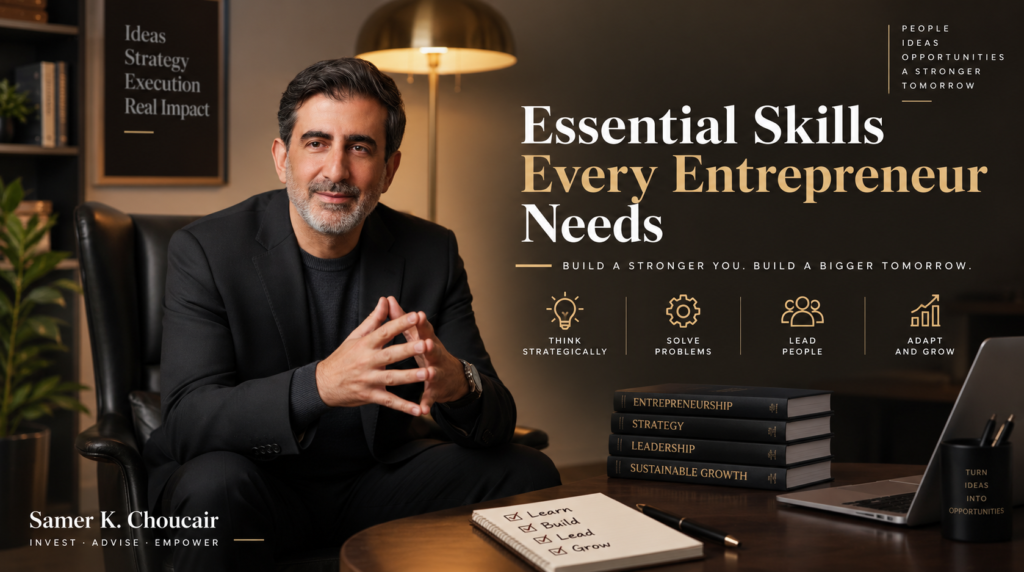
New founders often try to get good at everything at once — sales, operations, hiring, marketing — and end up mediocre across the board. In practice, a much shorter list of essential skills every entrepreneur needs determines whether a business survives its first year. Everything else can be learned, delegated, or outsourced later.
This breaks down what those skills actually are, why they matter more early on than any specific industry expertise, and how to build each one deliberately — even without a business background.
Key Takeaways
|
What Makes a Skill Essential for a New Founder
Most lists of business skills read like a job description for an entire company — marketing, operations, HR, sales, and more. That’s not useful for someone starting out, because it doesn’t distinguish between what an entrepreneur must personally be able to do and what can be hired, delegated, or learned much later.
The essential skills every entrepreneur needs are the ones that show up before there’s anyone else to hand them to — the decisions and conversations that fall to the founder by default, simply because no one else in the business exists yet.
Essential Skills Every Entrepreneur Needs
These five capabilities compound across nearly every stage of a growing business, regardless of industry.
01
Problem FramingDefining a business problem precisely enough that a real solution can be built and tested. |
02
Basic Financial LiteracyReading a simple profit-and-loss statement and pricing with real margin in mind. |
03
Communication and PersuasionExplaining an offer clearly enough that a stranger understands its value quickly. |
||
04
Decision-Making Under Incomplete InformationMoving forward on the best available evidence instead of waiting for certainty. |
05
Basic NegotiationHandling terms with suppliers, partners, and early customers, where almost nothing is fixed. |
|||
1. Problem Framing
Before a business can solve anything, the founder has to state the problem precisely — who has it, how often, and how painfully. Vague framing (“people want better service”) produces vague products. Specific framing (“small clinics lose two hours a day to manual appointment reminders”) produces something that can actually be tested and sold.
2. Basic Financial Literacy
This isn’t accounting expertise. It’s the ability to read a simple profit-and-loss statement, understand cash flow versus paper profit, and price a product with real margin in mind rather than guessing. Founders who skip this tend to discover pricing mistakes only after they’ve already scaled them.
3. Communication and Persuasion
Founders spend a disproportionate amount of early time explaining the business — to customers, partners, vendors, and sometimes investors. The skill isn’t eloquence; it’s clarity. Being able to state what the business does and why it matters in one sentence a stranger immediately understands.
4. Decision-Making Under Incomplete Information
Early-stage decisions almost never come with complete data. The skill is building a habit of gathering the highest-value information available in a reasonable timeframe, then deciding — rather than waiting for a certainty that isn’t coming.
5. Basic Negotiation
Suppliers, landlords, early hires, and first customers rarely offer fixed terms to a new business. Founders who can’t negotiate tend to accept the first terms offered, which compounds into a real cost disadvantage as the business grows.
How to Build These Skills Without a Business Background
None of these five skills require formal training. They’re built the same way any practical skill is built — through structured, repeated use.
|
01
|
Identify Your Weakest Skill HonestlyRate yourself against all five against real, recent decisions — not how capable you’d like to believe you are. |
|
02
|
Practice It Inside Real, Small DecisionsApply the skill deliberately in low-stakes situations first — a small negotiation, a minor pricing decision — before high-stakes ones. |
|
03
|
Study How Others Solved the Same ProblemLook for concrete examples of the specific skill in action, not general advice — a real negotiation, a real pricing decision. |
|
04
|
Get Feedback From Someone Outside Your CircleA mentor, advisor, or peer founder will catch blind spots that friends and family are unlikely to point out. |
|
05
|
Revisit and Adjust as the Business GrowsThe bar for each skill rises with company size — reassess periodically rather than assuming early competence is enough permanently. |
This is how founder skills actually get built in practice — not through a course completed before launch, but through repeated use once the business is already underway.
Entrepreneur Skills vs. Employee Skills
Many capable employees underestimate how different these skills feel without an organization around them. This is what typically changes.
| Factor | As an Employee | As an Entrepreneur |
| Decision-Making | Made by, or approved by, a manager | Made directly, often with no one to confirm it |
| Financial Involvement | Handled by finance or accounting | Directly responsible for pricing and cash flow |
| Communication Purpose | Reporting and status updates | Persuading customers, partners, and vendors |
| Negotiation Frequency | Occasional, often mediated by HR or procurement | Frequent, and usually done personally |
| Problem Ownership | Escalated to the responsible department | Owned personally, regardless of department |
Common Mistakes When Building These Skills
- Waiting to feel ready before starting. These skills develop through use, not preparation; waiting delays the only process that actually builds them.
- Outsourcing financial understanding entirely. Delegating bookkeeping is reasonable; not understanding your own numbers at all is not.
- Treating negotiation as confrontational. Most early negotiations are collaborative problem-solving, not a battle to win.
- Confusing confidence with clear communication. Sounding certain isn’t the same as being understood.
- Assuming these skills are fixed traits. Founders who treat them as learnable improve steadily; founders who treat them as innate tend to plateau early.
|
“ The skills that matter most in a business’s first year are rarely the ones taught in a classroom — they’re the ones learned by making a decision, seeing the result, and adjusting. A Perspective on Early-Stage Business Building |
Final Thoughts
The essential skills every entrepreneur needs aren’t a checklist to complete before starting a business — they’re a short list of capabilities worth building in parallel with it. Problem framing, financial literacy, communication, decision-making under uncertainty, and negotiation each compound as the business grows, regardless of the industry or the founder’s prior background.
Treat each one as a deliberate practice rather than a fixed trait, and the gap between a first-time founder and an experienced one narrows faster than most people expect.
FAQ
Frequently Asked Questions
What are the most essential skills every entrepreneur needs?
Problem framing, basic financial literacy, communication and persuasion, decision-making under incomplete information, and basic negotiation consistently matter most for first-time founders.
Can these skills be learned, or do you need natural talent?
They can be learned. Some people start with a natural inclination toward one or two of them, but all five develop through deliberate, repeated practice regardless of starting point.
What entrepreneur skill matters most in the first year?
Problem framing and basic financial literacy tend to matter most early, since they directly affect whether the offer and the pricing are sound before much money is spent.
Do I need financial skills if I’m not good with numbers?
You need enough financial literacy to read a basic profit-and-loss statement and price with margin in mind. Advanced accounting can be delegated; a basic understanding of your own numbers should not be.
How is negotiation different for entrepreneurs than for employees?
Employees often have HR or procurement mediate negotiations. Entrepreneurs typically negotiate directly and far more frequently — with suppliers, landlords, and early customers alike.
What’s the difference between entrepreneur skills and leadership skills?
Entrepreneur skills are about running the business itself — pricing, problem framing, negotiation. Leadership skills are specifically about leading a team once one exists. Many founders need both, at different stages.
How long does it take to develop essential entrepreneur skills?
Noticeable improvement in a single skill often appears within a few months of deliberate practice, though founders typically keep refining all five for as long as they’re running a business.
Can I start a business without having all these skills yet?
Yes. Most founders build these skills alongside the business rather than mastering them beforehand. Starting with awareness of the gaps is more useful than waiting to close them first.